
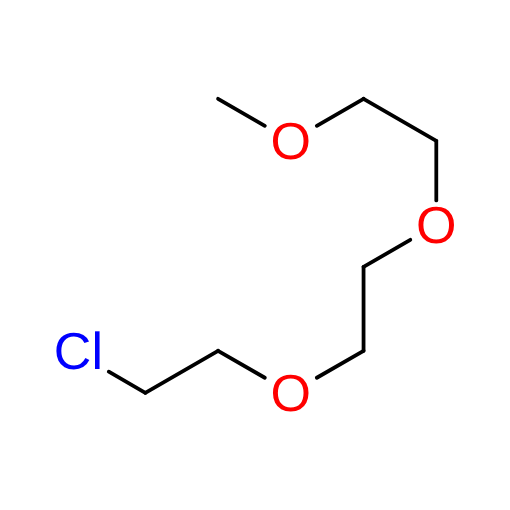
1-Chloro-2-(2-(2-methoxyethoxy)ethoxy)ethane (98%)
Molecular Formula: C7H15ClO3
CAS#: 52995-76-3
SMILES: ClCCOCCOCCOC
MDL#: None
Catalog#: AMTGC224-Cl16
Molecular weight: 182.65 g/mol
Appearance: colorless liquid
Purity: 98%
Storage: Room Temperature
Solubility: Dichloromethane, Chloroform, Methanol
Other names:
- Me-PEG2-CH2CH2Cl
- Methoxy-PEG2-Halide
Fields of Interest:
Functionalized PEGs, Organic synthesis, Oligoethylene glycol chemistry, Nucleophilic substitution, Parallel synthesis, Molecular tagging, Polymer chemistry
Background
1-Chloro-2-[2-(2-methoxyethoxy)ethoxy]ethane (CAS 52995-76-3) is a methoxy-capped, chloride-functionalized oligoethylene glycol building block used to introduce a short PEG chain into larger molecules. Its structure contains three ethylene units, three ether oxygen atoms, and a terminal primary alkyl chloride. The chloride provides a site for nucleophilic substitution, while the methyl ether caps the opposite end of the chain.
This combination allows attachment through one terminus while retaining a defined, flexible oligoether segment. Suitable oxygen nucleophiles can replace the chloride to form an ether linkage, providing a route to PEG-substituted molecular scaffolds. The fixed chain length is useful when preparing related compounds that differ systematically in their oligoethylene glycol content. Published research includes this exact compound in the preparation of molecular sorting tags, where differences in attached oligoether chains help researchers distinguish and separate products during parallel synthesis.
Applications
This functionalized PEG is particularly relevant to synthetic projects requiring a short, methoxy-terminated oligoether substituent.
Installation of PEG chains through ether formation: The terminal chloride can serve as the electrophilic site in nucleophilic substitution with suitable alkoxides or phenoxides. This chemistry offers a way to attach the methoxy-capped chain to alcohol- or phenol-derived scaffolds. Reaction conditions must suit both the nucleophile and the remaining functional groups of the target molecule.
Molecular sorting tags and parallel synthesis: The compound has been prepared as an intermediate in an oligoethylene glycol tagging strategy used to synthesize stereoisomeric hydroxybutenolide fragments related to murisolin and other acetogenins. Tags containing different oligoether chain lengths encode molecular identity and support chromatographic separation after shared reaction steps. This is a documented application of the specific building block.
Design of oligoether-containing materials: Its defined chain and single substitution site make it a candidate precursor for installing methoxy-terminated oligoether side chains into more complex building blocks. Related research on oligoethylene glycol-substituted polyisocyanates demonstrates how side-chain length and terminal groups can influence polymer behavior in water. That work provides materials-design context; the resulting polymer properties depend on the complete structure.
Literature:
- Canadian Journal of Chemistry, 1975, vol. 53, p. 2240 – 2246
- Gudipati, V.; Curran, D. P.; Wilcox, C. S. “Solution-Phase Parallel Synthesis with Oligoethylene Glycol Sorting Tags. Preparation of All Four Stereoisomers of the Hydroxybutenolide Fragment of Murisolin and Related Acetogenins.” The Journal of Organic Chemistry 2006, 71, 3599–3607.
- Includes preparation of this exact compound as intermediate 5c in a strategy using oligoethylene glycol tags to organize and separate stereoisomeric products.
- Sakai, N.; Jin, M.; Sato, S.; Satoh, T.; Kakuchi, T. “Synthesis of water-soluble polyisocyanates with the oligo(ethylene glycol) side-chain as new thermoresponsive polymers.” Polymer Chemistry 2014, 5, 1057–1062.
- Demonstrates how oligoethylene glycol side-chain structure affects polymer behavior in water, providing related-class context for materials research.