
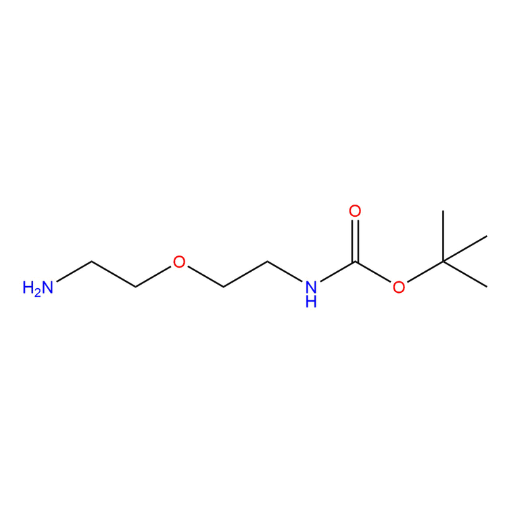
Name: tert-butyl (2-(2-aminoethoxy)ethyl)carbamate
Molecular Formula: C9H20N2O3
CAS#: 127828-22-2
SMILES: NCCOCCNC(OC(C)(C)C)=O
MDL#: MFCD12031501
Catalog#: AMTGC1577-TA26
Molecular weight: 204.27 g/mol
Other names:
- tert-Butyl N-[2-(2-aminoethoxy)ethyl]carbamate
- Boc-PEG2-amine
- N-Boc-PEG2-diamine
Fields of Interest: bioconjugation, drug delivery, and materials science
Background & Applications:
Background
tert-Butyl (2-(2-aminoethoxy)ethyl)carbamate is a protected amine-functionalized PEG derivative based on a PEG2 backbone, featuring a terminal Boc-protected primary amine and a free primary amine at the opposite end. The polyethylene glycol spacer provides hydrophilicity, flexibility, and compatibility with aqueous and biological environments, while the tert-butoxycarbonyl (Boc) group enables controlled, stepwise synthetic strategies by temporarily masking amine reactivity. The Boc protecting group can be readily removed under mild acidic conditions to generate a diamine PEG intermediate. This compound serves as a versatile building block within a comprehensive portfolio of functionalized PEGs designed for precise molecular assembly.
Applications
This Boc-PEG2-amine Boc-protected PEG diamine is commonly used in bioconjugation, drug delivery, and materials science applications where staged functional group exposure and selective reactivity are required. Typical uses include stepwise synthesis of multifunctional PEG linkers, selective PEGylation of small molecules, peptides, or polymers, and preparation of intermediates for pharmaceutical and biomaterials research. Following deprotection, the resulting diamine PEG can be used for coupling to activated carboxylic acids, NHS esters, and isocyanates. As part of a robust functionalized PEG product line, tert-Butyl (2-(2-aminoethoxy)ethyl)carbamate supports modular design strategies in specialty chemical synthesis, diagnostics, and advanced materials development.
Appearance: Pale-yellow liquid
Purity: 99%
Storage: -20 °C
Solubility: Dichloromethane, Chloroform, Methanol
Literature:
- European Journal of Medicinal Chemistry, 2016, vol. 117, p. 301 – 320
- MedChemComm, 2019, vol. 10, # 6, p. 1037 – 1041
- Journal of the American Chemical Society, 1994, vol. 116, # 5, p. 2211 – 2212