
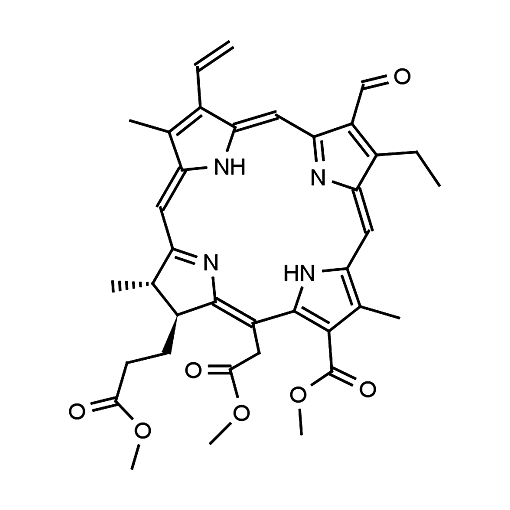
Rhodin G7 trimethyl ester
Molecular Formula: C37H40N4O7
CAS#: NONE
SMILES: CCC1=C(C=O)C2=N\C\1=C/C1=C(C)C(C(=O)OC)=C(N1)\C(CC(=O)OC)=C1/N=C(/C=C3NC(=C\2)/C(C=C)=C\3C)[C@@H](C)[C@@H]1CCC(=O)OC
MDL#: NONE
Catalog#: R11128
Molecular weight: 652.74 g/mol
Appearance: black solid
Purity: >90%
Storage: Store at -20 °C, protect from light.
Solubility: aqueous solvents with pH >7
Other names:
- Rhodin-g7 trimethyl ester
Fields of Interest
chlorophyll chemistry, chlorin chemistry, tetrapyrrole chemistry, natural pigment chemistry, chlorophyll b derivatives, photosensitizer research, photochemistry, pigment synthesis, chlorophyll degradation, bioorganic chemistry
Background
Rhodin G7 trimethyl ester is a chlorin-type tetrapyrrole derived from the chlorophyll b series and is the methyl-esterified form of rhodin G7. Structurally, it retains the partially hydrogenated tetrapyrrolic macrocycle characteristic of chlorins together with the formyl substituent associated with chlorophyll b-derived pigments. The three peripheral carboxyl functionalities of rhodin G7 are present as methyl esters, producing a neutral derivative that is particularly useful for organic-phase synthesis, purification, spectroscopy, and chemical modification.
Rhodin G7 occupies an important position in classical chlorophyll chemistry because it represents the chlorophyll b-series analogue of chlorin e6, which derives from chlorophyll a. The distinction between these pigment families is closely associated with the formyl functionality present in the chlorophyll b lineage. Rhodin G7 trimethyl ester has therefore been used both as a defined chlorophyll degradation product and as a synthetic intermediate for investigating transformations between naturally occurring chlorins. Its conjugated chlorin chromophore also gives it the light-absorbing characteristics expected of chlorophyll-derived tetrapyrroles, making it relevant to photochemical and photosensitizer research.
Applications
Rhodin G7 trimethyl ester is primarily used in chlorophyll-derived pigment synthesis, structural studies, and chlorin photochemistry.
- Chlorophyll b and chlorin chemistry: Rhodin G7 trimethyl ester provides a well-defined model of the chlorophyll b-derived chlorin framework. It has been prepared directly from chlorophyll b derivatives and used to study the chemistry connecting natural chlorophylls, pheophorbides, chlorins, and related tetrapyrroles.
- Synthetic chlorin building block: The aldehyde and peripheral substituents of the rhodin scaffold provide opportunities for further chemical transformation. Rhodin G7 trimethyl ester has been used as a starting material for preparing modified chlorins with altered side chains, supporting structure–property studies in natural and synthetic tetrapyrrole chemistry.
- Chlorophyll a/b interconversion research: A landmark partial synthesis converted chlorin e6 trimethyl ester, an a-series pigment derivative, into rhodin G7 trimethyl ester. This transformation helped establish chemical relationships between the chlorophyll a and chlorophyll b families and remains an important example of selective chlorin functionalization.
- Spectroscopic and pigment-reference studies: Rhodin G7 and its esterified derivatives are useful reference compounds in chromatographic, UV-visible, NMR, and mass-spectrometric studies of chlorophyll degradation products. The trimethyl ester is particularly suitable for studies conducted in organic media.
- Photosensitizer and photochemistry research: Direct biological studies of the trimethyl ester are limited, so it should not be presented as an established photodynamic therapy agent. However, related rhodin G7 derivatives have demonstrated light-dependent reactive oxygen species generation and photosensitizing activity, supporting continued investigation of the rhodin scaffold in photochemical and photobiological research.
Selected Literature
- Lötjönen, S.; Hynninen, P. H. “A Convenient Method for the Preparation of Chlorin e6 and Rhodin g7 Trimethyl Esters.” Synthesis 1980, 1980 (7), 541–543. DOI: 10.1055/s-1980-29113.
- This paper describes the direct preparation of rhodin G7 trimethyl ester from chlorophyll b-derived methyl pheophorbide and provides one of the most directly relevant synthetic methods for the exact compound.
- Smith, K. M.; Bushell, M. J.; Rimmer, J.; Unsworth, J. F. “Bacteriochlorophylls c from Chloropseudomonas ethylicum. Composition and NMR Studies of the Pheophorbides and Derivatives.” Journal of the American Chemical Society 1980, 102 (7), 2437–2448. DOI: 10.1021/ja00527a048.
- Rhodin G7 trimethyl ester is used directly as a synthetic starting material for model chlorins, allowing structural and NMR comparisons with naturally derived bacteriochlorophyll degradation products.
- Inhoffen, H. H.; Jäger, P.; Mählhop, R. “Zur weiteren Kenntnis des Chlorophylls und des Hämins, XXXII. Partialsynthese von Rhodin-g7-trimethylester aus Chlorin-e6-trimethylester, zugleich Vollendung der Harvard-Synthese des Chlorophylls a zum Chlorophyll b.” Justus Liebigs Annalen der Chemie 1971, 749, 109–116. DOI: 10.1002/jlac.19717490112.
- This foundational study reports the partial synthesis of rhodin G7 trimethyl ester from chlorin e6 trimethyl ester, demonstrating a chemical conversion between chlorophyll a- and chlorophyll b-series pigments and confirming the product against natural rhodin-derived material.
- Shrestha, R.; Lim, J.; Gurung, P.; et al. “Isolation, Identification, and Biological Activities of a New Chlorin e6 Derivative.” International Journal of Molecular Sciences 2024, 25, 7114. DOI: 10.3390/ijms25137114.
- This study examines the closely related rhodin G7 7¹-ethyl ester, a chlorophyll b-derived rhodin compound, and reports singlet-oxygen generation, cellular uptake, and light-dependent biological activity. Although it does not study the trimethyl ester itself, it supports the broader relevance of the rhodin G7 scaffold to photosensitizer research.