
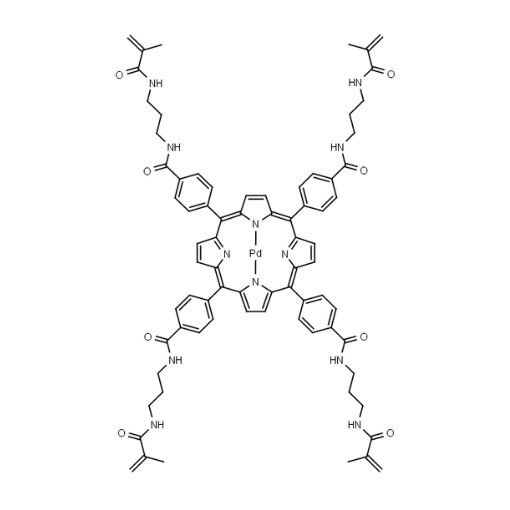
Pd(II) meso-Tetra(N-(3-methacrylamidopropyl)benzamido)porphine
Molecular Formula: C76H76N12O8Pd
CAS#: None
SMILES: CC(=C)C(=O)NCCCNC(=O)C1=CC=C(C=C1)C1=C2\C=CC(=N\2)/C(=C2/C=C\C3=C(\C4=N\C(\C=C4)=C(/C4=CC=C\1N4[Pd]N23)C1=CC=C(C=C1)C(=O)NCCCNC(=O)C(C)=C)C1=CC=C(C=C1)C(=O)NCCCNC(=O)C(C)=C)C1=CC=C(C=C1)C(=O)NCCCNC(=O)C(C)=C
MDL#: None
Catalog#: M35132
Molecular weight: 1391.91 g/mol
Appearance: Purple Solid
Purity: >95%
Storage: -20 C
Solubility: DMSO, DMF, Methylene Chloride, Chloroform
Other names:
- Pd(II) meso-Tetrakis[N-(3-methacrylamidopropyl)benzamido]porphine
- Palladium(II) meso-tetra[N-(3-methacrylamidopropyl)benzamido]porphyrin
- Methacrylamide-functionalized palladium porphyrin
- Polymerizable Pd(II) porphyrin
- Methacrylamide-functionalized PdTCPP derivative
Fields of Interest
oxygen sensing, optical sensors, phosphorescence lifetime sensing, porphyrin chemistry, polymer chemistry, hydrogel sensors, biosensors, biomaterials, dissolved oxygen measurement, tissue oxygen monitoring, microneedle sensors, photophysics, polymerizable chromophores
Background & Applications:
Pd(II) meso-Tetra(N-(3-methacrylamidopropyl)benzamido)porphine is a palladium metalloporphyrin designed to combine the oxygen-sensitive phosphorescence of Pd(II) porphyrins with polymerizable methacrylamide functionality. The molecule contains four peripheral methacrylamide groups that provide reactive sites for incorporation into acrylate- and methacrylate-based polymer networks.
The Pd(II) center promotes efficient intersystem crossing and formation of a long-lived triplet excited state. Molecular oxygen dynamically quenches the resulting phosphorescence, allowing changes in phosphorescence intensity or lifetime to be correlated with oxygen concentration. This fundamental photophysical behavior makes palladium porphyrins valuable probes for dissolved oxygen and oxygen partial-pressure measurements.
An important feature of this compound is its ability to be covalently incorporated into polymer and hydrogel matrices. Its methacrylamide groups enable photopolymerization or copolymerization with materials such as poly(2-hydroxyethyl methacrylate) (pHEMA) and other acrylate-based polymers. Covalent immobilization can reduce dye leaching and aggregation while maintaining the porphyrin within the oxygen-permeable sensing matrix. The compound has specifically been described in hydrogel-coated optical microneedles for phosphorescence-lifetime measurement of dissolved oxygen.
Potential applications include optical oxygen sensing, phosphorescence lifetime sensors, dissolved oxygen measurement, hydrogel biosensors, tissue oxygen monitoring research, microneedle sensing systems, polymer-based sensor films, and oxygen-responsive biomaterials.
Literature:
- Obata, M.; Matsuura, N.; Mitsuo, K.; Nagai, H.; Asai, K.; Harada, M.; Hirohara, S.; Tanihara, M.; Yano, S. “Oxygen-Sensing Properties of 5,10,15,20-Tetraphenylporphinato Platinum(II) and Palladium(II) Covalently Bound on Poly(isobutyl-co-2,2,2-trifluoroethyl methacrylate).” Journal of Polymer Science Part A: Polymer Chemistry 2010, 48, 663–670. DOI: 10.1002/pola.23818.
- This study prepared a polymerizable methacrylate-functionalized Pd(II) tetraphenylporphyrin and covalently incorporated it into an oxygen-permeable methacrylate copolymer. The work demonstrates the use of polymer-bound palladium porphyrins as phosphorescent oxygen-sensitive materials and closely parallels the design and intended functionality of this compound.
- Tian, Y.; Shumway, B. R.; Meldrum, D. R. “A New Cross-Linkable Oxygen Sensor Covalently Bonded into Poly(2-hydroxyethyl methacrylate)-co-Polyacrylamide Thin Film for Dissolved Oxygen Sensing.” Chemistry of Materials 2010, 22, 2069–2078. DOI: 10.1021/cm903361y.
- This work investigated a closely related metalloporphyrin containing four polymerizable methacrylate groups. Covalent incorporation into pHEMA-based hydrogels reduced sensor leaching and improved photostability while retaining dissolved-oxygen responsiveness, demonstrating the advantages of chemically incorporating porphyrin probes into polymer sensing matrices.
- Matesanz, A.; Ruiz-Llata, M.; Sanz-Horta, R.; et al. “Palladium Porphyrin-Modified Fibrin Hydrogel for Oxygen Sensing in Engineered Skin Tissue Applications.” ACS Omega 2026, 11, 30179–30187. DOI: 10.1021/acsomega.6c03389.
- This recent study developed a covalently immobilized palladium porphyrin within a hydrogel matrix for optical oxygen monitoring in engineered skin tissue. The porphyrin remained largely bound within the hydrogel and produced oxygen-dependent optical responses, illustrating current interest in immobilized Pd-porphyrin probes for biomaterials and tissue oxygen sensing.