
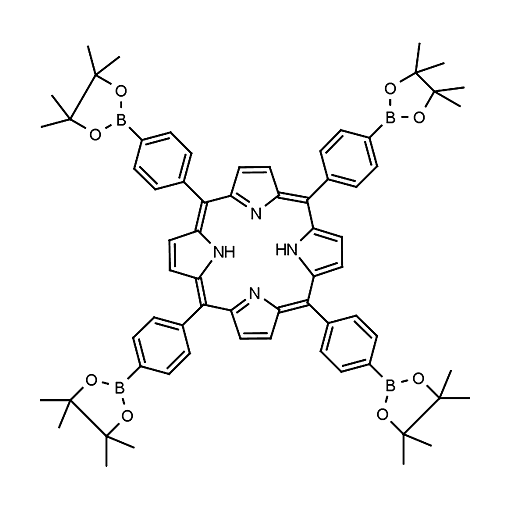
meso-Tetra[4-(dihydroxyboryl)phenyl]porphine tetra pinacol ester
Molecular Formula: C68H74B4N4O8
CAS#: 1332748-00-1
SMILES: B1(OC(C(O1)(C)C)(C)C)C2=CC=C(C=C2)C3=C4C=CC(=C(C5=NC(=C(C6=CC=C(N6)C(=C7C=CC3=N7)C8=CC=C(C=C8)B9OC(C(O9)(C)C)(C)C)C1=CC=C(C=C1)B1OC(C(O1)(C)C)(C)C)C=C5)C1=CC=C(C=C1)B1OC(C(O1)(C)C)(C)C)N4
MDL#: None
Catalog#: U34790
Molecular weight: 1118.58 g/mol
Appearance: Purple solid
Purity: >95%
Storage: room temperature
Solubility: Organic solvents
Other names:
- TBPinPP
- 5,10,15,20-Tetrakis[4-(4,4,5,5-tetramethyl-1,3,2-dioxaborolan-2-yl)phenyl]-21H,23H-porphine
- 5,10,15,20-Tetrakis[4-(4,4,5,5-tetramethyl-1,3,2-dioxaborolan-2-yl)phenyl]porphyrin
- 5,10,15,20-Tetrakis(4-boronic acid pinacol ester phenyl)porphyrin
- Tetrakis(4-pinacolboronatephenyl)porphyrin
Fields of Interest
porphyrin chemistry, boronic esters, Suzuki–Miyaura cross-coupling, porphyrin functionalization, organic synthesis, supramolecular chemistry, covalent organic frameworks, conjugated materials, porous materials, solid-state electrolytes, molecular electronics, functional materials
Background
meso-Tetra[4-(dihydroxyboryl)phenyl]porphine tetra pinacol ester (CAS 1332748-00-1) is a free-base tetraphenylporphyrin bearing four para-substituted pinacol boronate ester groups. With four independently reactive aryl-BPin sites positioned around the porphyrin macrocycle, the compound combines the optical and electronic characteristics of a conjugated porphyrin core with the synthetic versatility of organoboron chemistry. Its molecular formula is C₆₈H₇₄B₄N₄O₈ and its molecular weight is 1118.58 g/mol.
The peripheral pinacol boronate groups are particularly useful as Suzuki–Miyaura cross-coupling handles, allowing the porphyrin to be connected to aryl and heteroaryl partners through carbon–carbon bond formation. Because all four meso-phenyl groups carry a boronate ester, this compound can function as a tetrafunctional porphyrin building block for preparing highly substituted molecular architectures, extended conjugated systems, and multidirectional porphyrin-containing materials. The pinacol groups also provide a protected form of the corresponding boronic acid functionality, facilitating isolation and handling during multistep synthesis.
Applications
meso-Tetra[4-(dihydroxyboryl)phenyl]porphine tetra pinacol ester (CAS 1332748-00-1) is primarily useful as a multifunctional porphyrin building block for cross-coupling and advanced materials synthesis.
- Suzuki–Miyaura cross-coupling: The four aryl pinacol boronate groups provide multiple coupling sites for reaction with aryl or heteroaryl halides. This enables preparation of tetra-substituted porphyrins and larger conjugated structures from a common porphyrin precursor.
- Porphyrin conjugates and supramolecular systems: The compound has been used directly as a synthetic precursor for attaching crown ether units to a tetraphenylporphyrin framework. Such functionalization strategies allow recognition, host–guest, sensing, and stimulus-responsive functionality to be combined with the photophysical properties of porphyrins.
- Functional and conjugated materials: Tetrafunctional boronate-substituted porphyrins are useful starting points for constructing extended organic architectures. Related boron-functionalized porphyrin building blocks have been employed in porous and covalent organic materials where the porphyrin serves as an electronically active structural unit.
- Porphyrin–biomolecule conjugate research: This exact tetra(pinacol boronate) porphyrin has been prepared in research involving steroid–porphyrin conjugates. Its multiple boron-containing substituents provide routes to structurally elaborate porphyrin derivatives while retaining the central macrocyclic chromophore.
- Polymer solid-state electrolyte research: More recently, the exact compound, designated TBPinPP, has been evaluated as a molecular additive in poly(ethylene oxide)–LiTFSI solid-state electrolytes. This work examined how its pinacolato-boron functionality influences lithium-ion coordination, anion interactions, electrochemical behavior, and interfacial evolution, providing a newer application for this porphyrin beyond its traditional role as a synthetic intermediate.
Literature:
- Gogoi, P.; Kalita, N.; Scalzo, C. T.; Prakash, S.; Cook, T. R.; Li, Y. C. “Molecularly Tunable Porphyrin Additives Regulate Ion Coordination and Interfacial Evolution in PEO-Based Solid-State Electrolytes.” EES Batteries 2026. DOI: 10.1039/D6EB00092D.
- This study evaluates the exact compound, TBPinPP, as an additive in PEO–LiTFSI solid-state electrolytes, examining its influence on lithium-ion coordination, anion interactions, and electrochemical behavior.
- Fathalla, M. “Synthesis and Characterization of a Porphyrin-Crown Ether Conjugate as a Potential Intermediate for Drug Delivery Application.” Journal of Porphyrins and Phthalocyanines 2021, 25 (2), 95–101. DOI: 10.1142/S1088424620500546.
- This study uses the exact tetra(pinacol boronate) porphyrin as a Suzuki–Miyaura coupling precursor to prepare a tetra-crown-ether-functionalized porphyrin, demonstrating its utility as a multifunctional synthetic building block.
- Zhylitskaya, H. A.; Zhabinskii, V. N.; Litvinovskaya, R. P.; Lettieri, R.; Monti, D.; Venanzi, M.; Khripach, V. A.; Drasar, P. “Design and Studies of Novel Polyoxysterol-Based Porphyrin Conjugates.” Steroids 2012, 77 (11), 1169–1175. DOI: 10.1016/j.steroids.2012.07.005.
- This work reports the preparation and characterization of the exact tetra(pinacol boronate)-substituted porphyrin in research involving steroid–porphyrin conjugates and structurally complex porphyrin derivatives.
- Ren, Y.; Zhang, Y.-Y.; Jin, H.-G.; Gong, C.; Wei, Y.; Zhao, X.; Shang, W.; Sun, H.; Liang, Q.; Ma, J.; Hu, Y.; Zhang, X.-S.; Li, J.; Jiao, F.; Wu, Y.; Fu, H.; Li, Y.; Zhang, D. “Giant Cycloparaphenylene-Scaffolded Porphyrins as Photocatalysts.” Angewandte Chemie International Edition 2026, 65, e22603. DOI: 10.1002/anie.202522603.
- This study uses a related boronic ester-functionalized porphyrin in Suzuki coupling to construct large porphyrin–cycloparaphenylene conjugates, demonstrating the value of this functional group class for advanced photoactive molecular materials.
- Feng, X.; Chen, L.; Dong, Y.; Jiang, D. “Porphyrin-Based Two-Dimensional Covalent Organic Frameworks: Synchronized Synthetic Control of Macroscopic Structures and Pore Parameters.” Chemical Communications 2011, 47 (7), 1979–1981. DOI: 10.1039/C0CC04386A.
- This study examines related boron-functionalized porphyrin building blocks in the construction of ordered two-dimensional covalent organic frameworks, supporting their broader use in porous and electronically active materials.