
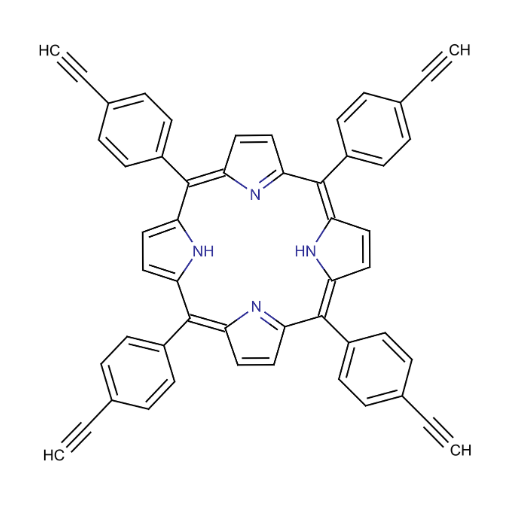
Meso-Tetra(4-ethynylphenyl)porphine (TEPP)
Molecular Formula: C52H30N4
CAS#: 160240-15-3
SMILES: C#CC1=CC=C(C=C1)C1=C2NC(\C=C/2)=C(/C2=N/C(/C=C2)=C(\C2=CC=C(N2)/C(=C2/C=CC\1=N/2)C1=CC=C(C=C1)C#C)C1=CC=C(C=C1)C#C)C1=CC=C(C=C1)C#C
MDL#: MFCD31700791
Catalog#: U34645
Molecular weight: 710.82 g/mol
Appearance: Purple solid
Purity: >95%
Storage: room temperature
Solubility: halogenated organic solvents such as dichloromethane (DCM), chloroform, and chlorobenzene, as well as some aromatic solvents such as toluene and tetrahydrofuran (THF) under suitable conditions.
Other names:
- TEPP
- meso-Tetra(4-ethynylphenyl)porphyrin
- 5,10,15,20-Tetrakis(4-ethynylphenyl)-21H,23H-porphine
- 5,10,15,20-Tetrakis(4-ethynylphenyl)porphyrin
- Tetrakis(4-ethynylphenyl)porphyrin
- Tetra(4-ethynylphenyl)porphyrin
Fields of Interest:
materials chemistry, nanotechnology, and photochemistry
Meso-Tetra(4-ethynylphenyl)porphine is of interest for:
- Covalent organic frameworks and conjugated porous polymers
- Sonogashira cross-coupling and molecular-network synthesis
- Porphyrin-functionalized electrodes and surfaces
- Chemical and electrochemical sensing
- Photonics, optoelectronics, and light-harvesting research
- Energy-conversion and energy-storage materials
- Metalloporphyrin synthesis and coordination chemistry
- Catalytic and photocatalytic material development
The four terminal alkyne groups make this porphyrin particularly useful as a multifunctional monomer. It has been employed in the preparation of ethynyl-linked porphyrin covalent organic frameworks and porphyrin-based porous organic polymers.
The free-base porphyrin cavity may also be metalated with selected transition metals, allowing researchers to tune the optical, electrochemical, catalytic, and coordination properties of the resulting material.
Background & Applications:
meso-Tetra(4-ethynylphenyl)porphine is a free-base porphyrin featuring four terminal ethynyl groups positioned on the para-substituted phenyl rings. It is commonly used as a functional molecular building block in porphyrin-based polymers, covalent organic frameworks, surface-modified materials, sensors, and optoelectronic research.
The compound combines the light-absorbing and electronically conjugated porphyrin core with four reactive terminal alkyne groups. These ethynyl groups support Sonogashira and related coupling reactions, enabling incorporation into extended π-conjugated networks, porous organic materials, electrode coatings, and other functional molecular architectures.
5,10,15,20-Tetra(4-ethynylphenyl)porphyrin (TEPP) is a synthetic porphyrin derivative consisting of a central porphyrin ring substituted with four para-ethynylphenyl groups, which provide excellent optical, electronic, and chemical properties. The terminal ethynyl groups allow further functionalization through coupling reactions, making TEPP a versatile building block for advanced molecular architectures. It is widely applied in organic electronics, light-harvesting and solar energy conversion, chemical sensing, catalysis and nanotechnology due to its strong light absorption, efficient charge transport, and ability to form stable metal complexes.
Literature:
- Bonnett, R. (2000). Chemical Aspects of Photodynamic Therapy. Gordon and Breach Science Publishers.
- Drain, C. M., Varotto, A., & Radivojevic, I. (2009). Self-organized porphyrinic materials. Chemical Reviews, 109(5), 1630-1658.
- Kadish, K. M., Smith, K. M., & Guilard, R. (Eds.). (2000). The Porphyrin Handbook (Vols. 1-10). Academic Press.
- He, S.; et al. “An Ethynyl-Linked sp-Carbon-Conjugated Covalent Organic Framework through Sonogashira Cross-Coupling Reactions.” Journal of the American Chemical Society 2025, 147, 19667–19674. DOI: 10.1021/jacs.5c01709.
- “Integrating Porphyrin-Based Nanoporous Organic Polymers with Electrochemical Aptasensors for Ultratrace Detection of Kanamycin.” Microchimica Acta 2024. The study used TEPP in Sonogashira-coupled porous organic polymers for electrochemical sensing.
- “Porphyrin-Based Porous Organic Frameworks for the Ultrasensitive Electrochemical Impedimetric Aptasensing of Oxytetracycline.” The reported framework was prepared from TEPP and subsequently metalated to produce an iron-porphyrin porous material.