
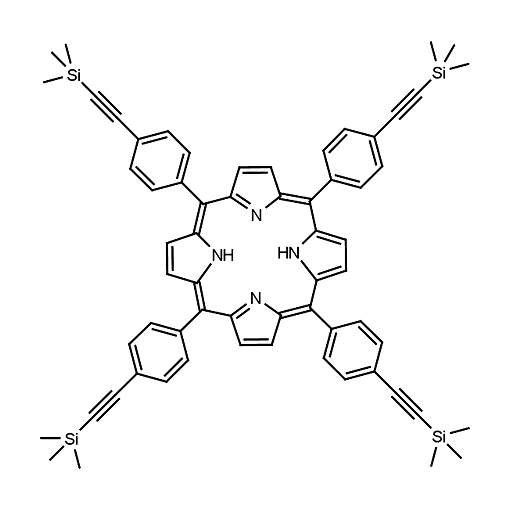
meso-Tetra [4-[2-(trimethylsilyl)ethynyl]phenyl] porphine
Molecular Formula: C64H62N4Si4
CAS#: 145362-97-6
SMILES: C[Si](C)(C)C#CC1=CC=C(C=C1)C1=C2NC(\C=C/2)=C(/C2=N/C(/C=C2)=C(\C2=CC=C(N2)/C(=C2/C=CC\1=N/2)C1=CC=C(C=C1)C#C[Si](C)(C)C)C1=CC=C(C=C1)C#C[Si](C)(C)C)C1=CC=C(C=C1)C#C[Si](C)(C)C
MDL#: None
Catalog#: U34644
Molecular weight: 999.55 g/mol
Appearance: Purple solid
Purity: >95%
Storage: store at –20 C for long term storage
Solubility: organic solvents
Other names:
- 5,10,15,20-Tetrakis[4-[2-(trimethylsilyl)ethynyl]phenyl]porphyrin
- 5,10,15,20-Tetrakis[4-((trimethylsilyl)ethynyl)phenyl]porphyrin
- 5,10,15,20-Tetrakis(4-trimethylsilylethynylphenyl)porphyrin
- TMS-protected tetrakis(4-ethynylphenyl)porphyrin
Fields of Interest
porphyrin chemistry, non-linear optics, terminal alkyne synthesis, protected ethynyl porphyrins, conjugated microporous polymers, porous organic materials, Sonogashira coupling, Glaser coupling, metalloporphyrins, photodetectors, photocurrent generation, carbon dioxide capture, heterogeneous catalysis, electrocatalyst precursors
Background
meso-Tetra[4-[2-(trimethylsilyl)ethynyl]phenyl] Porphine (CAS 145362-97-6) is a free-base tetraphenylporphyrin bearing four para-substituted trimethylsilyl-protected ethynyl groups. The porphyrin macrocycle provides a strongly conjugated, photoactive core, while the four peripheral TMS-protected alkynes provide chemically addressable sites for preparing terminal-alkyne-functionalized porphyrins.
The trimethylsilyl groups function primarily as alkyne protecting groups. Their removal produces 5,10,15,20-tetrakis(4-ethynylphenyl)porphyrin, a tetrafunctional building block that can participate in carbon–carbon bond-forming reactions and network formation. This combination of a porphyrin chromophore with four protected ethynyl substituents makes CAS 145362-97-6 particularly useful as a synthetic precursor for conjugated polymers, porous organic networks, organometallic porphyrin assemblies, and photoactive materials. The free-base macrocycle can also be metalated before deprotection, allowing metal-centered functionality to be introduced while the reactive alkyne groups remain protected.
Applications
CAS 145362-97-6 is primarily used as a protected porphyrin building block for terminal-alkyne functionalization and extended conjugated materials.
- Terminal ethynyl porphyrin synthesis: Removal of the four TMS protecting groups generates tetrakis(4-ethynylphenyl)porphyrin. The resulting terminal alkynes provide multiple reactive sites for homocoupling, cross-coupling, surface attachment, and construction of larger molecular architectures.
- Conjugated microporous polymers: The exact compound has been used as the protected precursor to tetraethynylporphyrin monomers that undergo alkyne coupling to form porous conjugated networks. These materials have been investigated for CO₂ adsorption, gas selectivity, and heterogeneous organocatalysis.
- Photoactive films and photodetectors: Metalation and subsequent alkyne deprotection provide porphyrin building blocks suitable for covalent layer-by-layer assembly. Zinc porphyrins prepared through this route have been incorporated into photoactive multilayer films and evaluated for light-induced photocurrent generation.
- Metalloporphyrin and electrocatalyst precursors: The protected free-base porphyrin can be converted to Fe, Co, Zn, and other metalloporphyrin derivatives before the ethynyl groups are exposed. This strategy has been used to prepare metal-containing conjugated polymer precursors for electrocatalytic materials.
- Porous and sensing materials: The corresponding terminal-ethynyl derivative has been incorporated into microporous porphyrin networks through Sonogashira-type coupling. Such networks have been investigated for chemical sensing, including responses to acidic and basic gases.
Selected Literature
- Dou, J.; Luo, H.; Zhang, C.; Lu, J.; Luan, X.; Guo, W.; Zhang, T.; Bian, W.; Bai, J.; Zhang, X.; Zhou, B. “Bimetallic Conjugated Microporous Polymer Derived B,N-Doped Porous Carbon Wrapped Co₃Fe₇ Alloy Composite as a Bifunctional Oxygen Electrocatalyst for a Breathing Zn–Air Battery.” New Journal of Chemistry 2021, 45, 21020–21030. DOI: 10.1039/D1NJ04063D.
- The synthesis uses the exact TMS-protected porphyrin directly as the precursor to Fe- and Co-containing tetraethynyl porphyrins, which are incorporated into conjugated microporous polymers and subsequently converted into bifunctional oxygen electrocatalysts for Zn–air battery research.
- Vonhoeren, B.; Dalgleish, S.; Hu, L.; Matsushita, M. M.; Awaga, K.; Ravoo, B. J. “Photocurrent Generation in Organic Photodetectors with Tailor-Made Active Layers Fabricated by Layer-by-Layer Deposition.” ACS Applied Materials & Interfaces 2015, 7 (13), 7049–7053. DOI: 10.1021/am509031u.
- This work uses the exact free-base TMS-protected compound as a synthetic precursor to Zn porphyrin building blocks for covalent layer-by-layer photoactive films, demonstrating their application in organic photodetectors and photocurrent-generating materials.
- Liu, X.; A, S.; Zhang, Y.; Luo, X.; Xia, H.; Li, H.; Mu, Y. “A Porphyrin-Linked Conjugated Microporous Polymer with Selective Carbon Dioxide Adsorption and Heterogeneous Organocatalytic Performances.” RSC Advances 2014, 4, 6447–6453. DOI: 10.1039/C3RA46988C.
- The researchers prepare the exact TMS-protected porphyrin, remove the trimethylsilyl groups to obtain tetrakis(4-ethynylphenyl)porphyrin, and use the resulting monomer to form a porous conjugated network with CO₂ adsorption and recyclable organocatalytic activity.
- Ryu, S. H.; Kang, C. W.; Choi, J.; Myung, Y.; Ko, Y.-J.; Lee, S. M.; Kim, H. J.; Son, S. U. “Microporous Porphyrin Networks Mimicking a Velvet Worm Surface and Their Enhanced Sensitivities toward Hydrogen Chloride and Ammonia.” ACS Applied Materials & Interfaces 2018, 10, 7171–7177. DOI: 10.1021/acsami.7b19119.
- This study uses the terminal-ethynyl derivative obtained after deprotection of this TMS-protected scaffold to construct aligned microporous porphyrin networks by Sonogashira coupling, with the resulting materials showing enhanced HCl and ammonia gas sensing.
- Onitsuka, K.; Kitajima, H.; Fujimoto, M.; Iuchi, A.; Takei, F.; Takahashi, S. “Platinum–Acetylide Dendrimers Possessing a Porphyrin Core.” Chemical Communications 2002, 2576–2577. DOI: 10.1039/B206254B.
- This work uses the closely related deprotected tetra(4-ethynylphenyl)porphyrin framework to construct platinum–acetylide dendrimers and demonstrates intramolecular energy transfer from the organometallic dendritic units to the porphyrin core.