
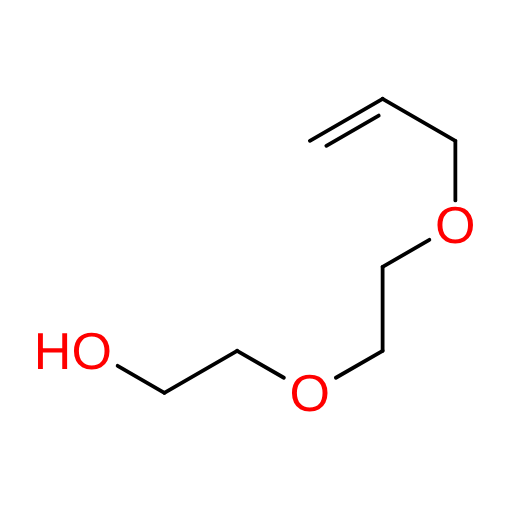
Diethylene glycol monoallyl ether (98%)
Molecular Formula: C7H14O3
CAS#: 15075-50-0
SMILES: C=CCOCCOCCO
MDL#: MFCD00078367
Catalog#: AMTGC789-DG21
Molecular weight: 146.18 g/mol
Appearance: colorless liquid
Purity: 98%
Storage: Room Temperature
Solubility: Dichloromethane, Chloroform, Methanol
Other names:
- 2-(2-allyloxyethoxy)ethanol
- Diethylene glycol monoallyl ether
- Allyl-PEG2-OH
- Allyldiglycol
- Allyl Carbitol
- 2-[2-(Allyloxy)ethoxy]ethanol
- 2-(2-(Allyloxy)ethoxy)ethan-1-ol
- 3,6-Dioxa-8-nonen-1-ol
- Allyloxy(diethylene oxide)
Fields of Interest:
Functionalized PEGs, allyl-functionalized PEGs, hydroxy PEGs, organic synthesis, polymer chemistry, polyurethane synthesis, surface modification, materials science, linker synthesis, monomer development, specialty chemical synthesis
Background
Diethylene glycol monoallyl ether (CAS 15075-50-0) is a compact, heterobifunctional oligoether containing a terminal allyl group and a terminal primary alcohol separated by a diethylene glycol-derived chain. The molecule combines two distinct synthetic handles with a short, flexible ether-rich spacer, making it useful as a building block for further functionalization and incorporation into polymers and other molecular architectures. NIST identifies the compound as 2-[2-(2-propenyloxy)ethoxy]ethanol with formula C₇H₁₄O₃ and molecular weight 146.1843 g/mol.
The primary hydroxyl group provides access to conventional alcohol chemistry, including esterification, etherification, urethane formation, and conversion to other functional groups. The terminal allyl group offers a separate alkene functionality that can participate in reactions such as thiol–ene addition, hydrosilylation, radical transformations, and polymer-related functionalization under appropriate conditions. This combination allows one functionality to be modified while preserving the other for subsequent chemistry.
Unlike polymeric PEG materials, Allyl-PEG2-OH is a discrete, low-molecular-weight compound with a defined structure. Its two ether oxygens introduce polarity and conformational flexibility while the allyl terminus provides a versatile carbon–carbon double bond for further modification. These characteristics make the compound useful as both a functionalized PEG building block and a reactive intermediate in materials and polymer chemistry.
Applications
Diethylene glycol monoallyl ether is particularly useful in polymer and materials synthesis, where the hydroxyl group can be incorporated into polymer architectures while leaving the allyl functionality available for subsequent modification. Direct literature precedent includes its use as an end-capping component in the preparation of monoallyl-functionalized polyurethane surfactants. In this approach, the hydroxyl group participates in polyurethane formation while the allyl group provides additional functionality in the resulting material.
The terminal alcohol also allows the compound to serve as a precursor to esters, carbamates, carbonates, ethers, and other functional derivatives. This makes Allyl-PEG2-OH useful as a starting material for preparing more specialized PEG reagents in which the allyl group is retained for downstream chemistry.
Conversely, the allyl functionality can be exploited to attach the oligoether segment to other molecular or material components. Thiol–ene chemistry can provide a route to thioether-linked products, while hydrosilylation can be used to introduce the ether-rich chain onto appropriate silicon-containing compounds. Such reactions make allyl-functionalized oligoethers useful in the preparation of modified surfaces, polymers, surfactants, and functional materials.
The compound’s short diethylene glycol segment provides a balance between the hydrophobic character of the allyl terminus and the polarity of the ether and hydroxyl groups. This makes it relevant to surfactant and amphiphilic-material development, where molecular structure can be adjusted to influence interfacial properties, compatibility, and dispersibility.
Within a functionalized PEG portfolio, Allyl-PEG2-OH is also useful as a precursor for custom linker synthesis. The hydroxyl terminus can be transformed into other reactive groups while retaining the allyl group, or the alkene can be selectively modified while retaining the alcohol. This provides a compact platform for sequential functionalization and modular molecular assembly.
Literature:
- Advanced Synthesis and Catalysis, 2005, vol. 347, # 2-3, p. 447 – 462
- Journal of applied chemistry of the USSR, 1982, vol. 55, # 5, p. 1050 – 1053
- Advanced Synthesis and Catalysis, 2005, vol. 347, # 2-3, p. 447 – 462
- Naghash, H. J.; Iravani, M.; Akhtarian, R. “Synthesis and Characterization of Monoallyl-End-Capped Diethylene Oxide-Based Polyurethane Surfactant.” Synthesis and Reactivity in Inorganic, Metal-Organic, and Nano-Metal Chemistry 2014, 44, 927–934. DOI: 10.1080/15533174.2013.790441.
- This study provides exact-compound application precedent for diethylene glycol monoallyl ether. The compound was synthesized from diethylene glycol and allyl chloride and subsequently incorporated into a functional polyurethane surfactant through reaction with hexamethylene diisocyanate and polypropylene glycol. The resulting polyurethane surfactant was evaluated in emulsion polymerization and demonstrated surface-active behavior, supporting the use of CAS 15075-50-0 in polyurethane, surfactant, and polymer-material development.
- Sun, X.-G.; Kerr, J. B.; Reeder, C. L.; Liu, G.; Han, Y. “Network Single Ion Conductors Based on Comb-Branched Polyepoxide Ethers and Lithium Bis(allylmalonato)borate.” 2004.
- This research is indexed in connection with CAS 15075-50-0 and examines oligoether-containing materials designed for lithium-ion transport. The work provides relevant context for the use of allyl- and ether-functional building blocks in polymer electrolyte and functional-material architectures.