
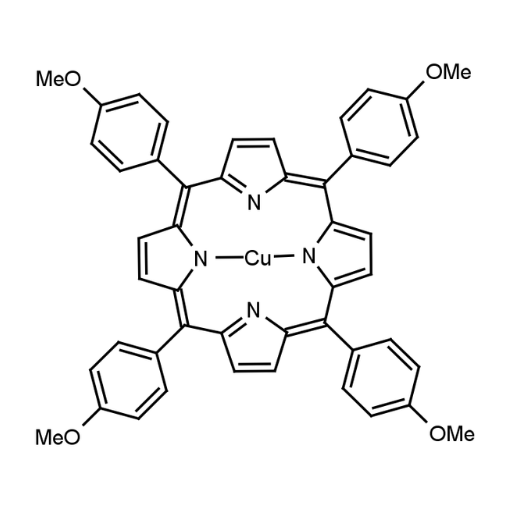
Cu(II) meso-Tetra(4-methoxyphenyl) porphine
Molecular Formula: C48H36CuN4O4
CAS#: 24249-30-7
SMILES: COC1=CC=C(C=C1)C2=C3C=CC(=C(C4=NC(=C(C5=CC=C([N-]5)C(=C6C=CC2=N6)C7=CC=C(C=C7)OC)C8=CC=C(C=C8)OC)C=C4)C9=CC=C(C=C9)OC)[N-]3.[Cu+2]
MDL#: None
Catalog#: M40870
Molecular weight: 796.39 g/mol
Appearance: Red/purple solid
Purity: >95%
Storage: Room temperature
Solubility: Organic solvents
Other names:
- Copper(II) tetrakis(4-methoxyphenyl)porphyrin
- Copper(II) 5,10,15,20-tetrakis(4-methoxyphenyl)porphyrin
- Cu(II) tetrakis(4-methoxyphenyl)porphyrin
- CuTOMPP
- CuTMPP
- Cu-T(OMe)PP
Fields of Interest:
copper porphyrins, electrocatalysis, CO₂ reduction, electrochemistry, molecular catalysis, carbon dioxide conversion, methane production research, redox chemistry, coordination chemistry, functional materials, bioinorganic chemistry
Background & Applications:
Copper(II) meso-Tetra(4-methoxyphenyl)porphine is a Cu(II) metalloporphyrin containing four electron-donating methoxy groups at the para positions of the meso-phenyl rings. These peripheral methoxy substituents modify the electronic environment of the conjugated porphyrin macrocycle and can influence redox behavior, electron transfer, and interactions at the central copper ion.
The combination of a redox-active Cu(II) center with an electronically tunable porphyrin ligand makes CuTOMPP useful in electrocatalysis and molecular electrochemistry. The compound has been studied directly as a molecular catalyst for the electrochemical reduction of carbon dioxide, where the methoxy substituents were shown to influence electron transfer and catalytic performance.
CuTOMPP and related copper porphyrins are also used to investigate structure–property relationships, redox chemistry, catalytic reaction mechanisms, and substituted metalloporphyrin behavior. Additional studies have examined the electrochemical and biological properties of CuTOMPP alongside other substituted copper tetraphenylporphyrins.
Literature:
- Jiang, H.; Zhao, P.; Shen, H.; Yang, S.; Gao, R.; Guo, Y.; Cao, Y.; Zhang, Q.; Zhang, H. “New Insight into the Electronic Effect for Cu Porphyrin Catalysts in Electrocatalytic of CO₂ into CH₄.” Small 2024, 20, e2304998. DOI: 10.1002/smll.202304998.
This study evaluates copper(II) tetrakis(4-methoxyphenyl)porphyrin directly as a molecular catalyst for electrochemical CO₂ reduction. The researchers compared methoxy-, hydrogen-, and bromo-substituted copper porphyrins and found that the methoxy groups altered the electronic structure of the Cu center and promoted electron transfer during CO₂ reduction. The work highlights CuTOMPP as a useful model compound for studying substituent effects in molecular electrocatalysis.
- Boonyuen, S.; Shanmugam, P.; Rajan, R.; Phromsatit, T.; Teerawatananond, T.; Tantayanon, S.; Arpornmaeklong, P.; Shirosaki, Y. “Exploring copper (II) porphyrin complexes and their derivatives for electrochemical analysis and biological assessment in the study of breast cancer (MCF-7) cell lines.” Environmental Research 2024, 250, 118489. DOI: 10.1016/j.envres.2024.118489.
- This work compares a series of substituted Cu(II) tetraphenylporphyrins, including copper(II) tetrakis(4-methoxyphenyl)porphyrin (CuTOMPP). The compounds were characterized spectroscopically and electrochemically, demonstrating how peripheral substituents influence porphyrin electronic properties. The study also evaluated their activity in MCF-7 cell models, with CuTOMPP showing notable activity among the compounds tested.