
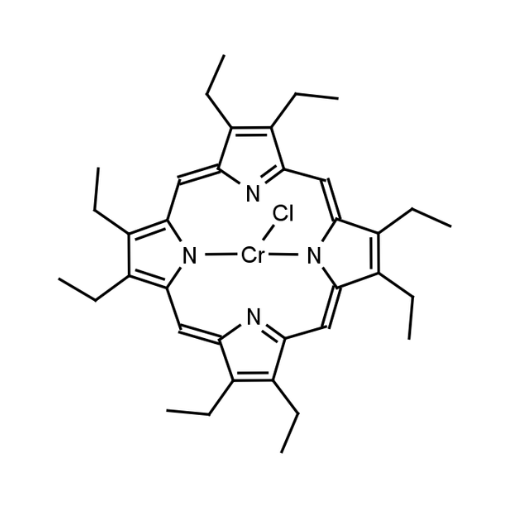
Cr(III) Octaethylporphine chloride
Molecular Formula: C36H44ClCrN4
CAS#: 65024-11-5
SMILES: CCC1=C(CC)C2=N\C\1=C/C1=C(CC)C(CC)=C3N1[Cr](Cl)N1C(=C\2)/C(CC)=C(CC)\C1=C\C1=N\C(=C/3)\C(CC)=C1CC
MDL#: None
Catalog#: O34120
Molecular weight: 620.21 g/mol
Appearance: Dark red to red-purple crystalline solid
Purity: >95%
Storage: room temperature
Solubility: Organic solvents
Other names:
- Chromium(III) octaethylporphyrin chloride
- Chloro(octaethylporphyrinato)chromium(III)
- Chloro(2,3,7,8,12,13,17,18-octaethylporphyrinato)chromium(III)
- Chromium(III) 2,3,7,8,12,13,17,18-octaethylporphyrin chloride
- Cr(OEP)Cl
- (OEP)CrCl
Fields of Interest
Polymerization catalysis, nitrogen atom transfer, epoxide carbonylation, metalloporphyrin chemistry, chromium porphyrins, coordination chemistry, photochemistry, ligand exchange, oxygen atom transfer, nitrogen atom transfer, redox chemistry, reaction kinetics, mechanistic inorganic chemistry, biomimetic chemistry, high-valent metal-oxo chemistry
Background & Applications:
Chromium(III) octaethylporphine chloride, commonly abbreviated Cr(OEP)Cl, is a chromium metalloporphyrin based on the octaethylporphyrin (OEP) macrocycle. Eight ethyl substituents surround the conjugated porphyrin framework, while Cr(III) occupies the central coordination site with chloride serving as an axial ligand. This combination makes Cr(OEP)Cl a useful model compound for investigating the coordination, redox, and photochemical behavior of chromium porphyrins.
Cr(OEP)Cl has been used extensively in studies of axial ligand binding and substitution. Chromium(III) octaethylporphyrin complexes can coordinate additional ligands such as water, pyridine, imidazole derivatives, and phosphine oxides. Laser photolysis studies have shown that photoexcitation can generate coordinatively unsaturated Cr(OEP)Cl intermediates, allowing researchers to examine ligand association, dissociation, and exchange kinetics.
The compound is also useful in atom-transfer and redox chemistry. Cr(OEP)Cl has been employed in oxygen-atom-transfer reactions with high-valent oxochromium porphyrins, providing insight into electron transfer and μ-oxo-mediated reaction pathways. Related chromium octaethylporphyrins have also been studied in nitrogen-atom-transfer chemistry involving high-valent nitridochromium species.
Potential research applications include chromium porphyrin photochemistry, axial ligand exchange, coordination kinetics, oxygen- and nitrogen-atom transfer, high-valent chromium chemistry, redox mechanism studies, and biomimetic metalloporphyrin research.
Literature:
- Chatterjee, C.; Chisholm, M. H. “Influence of the Metal (Al, Cr, and Co) and the Substituents of the Porphyrin in Controlling the Reactions Involved in the Copolymerization of Propylene Oxide and Carbon Dioxide by Porphyrin Metal(III) Complexes. 2. Chromium Chemistry.” Inorganic Chemistry 2012, 51 (21), 12041–12052. DOI: 10.1021/ic302137w.
- This study investigates a series of chromium(III) porphyrins, including chromium(III) octaethylporphyrin complexes, as catalysts for the polymerization of propylene oxide and its copolymerization with CO₂. The researchers compared octaethylporphyrin (OEP), tetraphenylporphyrin (TPP), and tetrakis(pentafluorophenyl)porphyrin (TFPP) chromium complexes and examined how porphyrin structure, axial ligands, and cocatalysts influence polymer formation and CO₂ incorporation. The work demonstrates the utility of chromium porphyrins in CO₂ utilization, epoxide polymerization, and mechanistic studies of metalloporphyrin catalysis.
- Neely, F. L.; Bottomley, L. A. “Inter-Metal Nitrogen Atom Transfer Reactions between Nitridochromium(V) and Chromium(III) Porphyrins.” Inorganic Chemistry 1997, 36 (24), 5432–5434. DOI: 10.1021/ic960918k.
- This work examines reversible nitrogen-atom transfer between nitridochromium(V) and chromium(III) porphyrins, including nitridochromium(V) octaethylporphyrin. Kinetic studies showed that electronic changes to the porphyrin strongly affect reaction rates and equilibria, and the authors proposed a bimetallic μ-nitrido intermediate for the transfer process. The study highlights the ability of the chromium–octaethylporphyrin framework to support high-valent chromium species and participate in atom-transfer and redox chemistry.
- Inamo, M.; Matsubara, N.; Nakajima, K.; Iwayama, T. S.; Okimi, H.; Hoshino, M. “Laser Photolysis Studies of the Reaction of Chromium(III) Octaethylporphyrin Complex with Triphenylphosphine and Triphenylphosphine Oxide.” Inorganic Chemistry 2005, 44, 6445–6455. DOI: 10.1021/ic0504487.
- This study examines chromium(III) octaethylporphyrin complexes based directly on Cr(OEP)Cl using laser flash photolysis. Photoexcitation generated a coordinatively unsaturated Cr(OEP)Cl intermediate, allowing the researchers to investigate axial ligand association and substitution involving water, pyridine, triphenylphosphine, and triphenylphosphine oxide. The work demonstrates the value of Cr(OEP)Cl for studying metalloporphyrin photochemistry and coordination kinetics.
- Inamo, M.; Eba, K.; Nakano, K.; Itoh, N.; Hoshino, M. “Laser Photolysis Studies of the Photochemical Reactions of Chromium(III) Octaethylporphyrin and Tetramesitylporphyrin Complexes in Toluene Solution.” Inorganic Chemistry 2003, 42, 6095–6105. DOI: 10.1021/ic0342696.
- This work investigates Cr(III) octaethylporphyrin complexes of the form [Cr(OEP)(Cl)(L)] and shows that irradiation can cause axial ligand photodissociation to form five-coordinate Cr(OEP)Cl. Subsequent reactions with water and other ligands were used to characterize ligand-exchange mechanisms and the influence of peripheral porphyrin substitution on chromium coordination chemistry.
- Woo, L. K.; Goll, J. G.; Berreau, L. M.; Weaving, R. “Oxygen Atom Transfer Reactions of Chromium Porphyrins: An Electronic Rationale for Oxo Transfer versus μ-Oxo Product Formation.” Journal of the American Chemical Society 1992, 114, 7411–7415. DOI: 10.1021/ja00045a012.
- This study uses (octaethylporphyrinato)chromium(III) chloride, Cr(OEP)Cl, directly in an oxygen-atom-transfer reaction with an oxochromium(IV) porphyrin. The reversible reaction generated an oxochromium OEP complex and provided mechanistic evidence for an inner-sphere pathway involving a μ-oxo intermediate, illustrating the usefulness of Cr(OEP)Cl for studying metalloporphyrin redox and atom-transfer chemistry.