
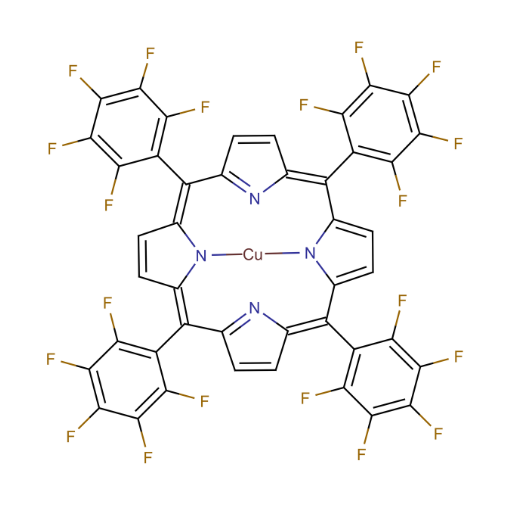
Cu(II) meso-Tetra(pentafluorophenyl)porphine / Cu(II)TFPP
Molecular Formula: C44H8CuF20N4
CAS#: None Yet
SMILES: FC1=C(F)C(F)=C(C(F)=C1F)C1=C2\C=CC(=N\2)/C(=C2/C=C\C3=C(\C4=N\C(\C=C4)=C(/C4=CC=C\1N4[Cu]N23)C1=C(F)C(F)=C(F)C(F)=C1F)C1=C(F)C(F)=C(F)C(F)=C1F)C1=C(F)C(F)=C(F)C(F)=C1F
MDL#: None
Catalog#: T40174
Molecular weight: 1036.07 g/mol
Other names:
- Copper(II) tetrakis(pentafluorophenyl)porphyrin
- Cu(II)TFPP
- CuTFPP
- CuTPP(F)
Fields of Interest: catalysis, materials chemistry, sensing, and photochemistry.
Cu(II)TFPP is commonly investigated in:
- Electrochemical carbon dioxide reduction
- Molecular electrocatalysis
- Copper-porphyrin redox chemistry
- Surface-supported molecular films
- Electronic-structure and spectroscopic studies
- Modified electrodes and functional materials
- Comparative studies of fluorinated metalloporphyrins
- Porphyrin functionalization and hybrid-material development
Background & Applications:
A peer-reviewed study reported that copper(II) tetrakis(pentafluorophenyl)porphyrin can catalyze the electrochemical reduction of carbon dioxide to carbon monoxide under defined laboratory conditions. The strong electron-withdrawing effect of the pentafluorophenyl substituents was identified as an important contributor to its catalytic behavior.
Cu(II)TFPP has also been studied using X-ray absorption spectroscopy and computational methods to evaluate how fluorination affects the electronic structure of copper porphyrin complexes. These properties make the compound relevant to research in energy conversion, molecular electronics, surface science, and inorganic chemistry.
Background: Copper(II) meso-tetra(pentafluorophenyl)porphine, also known as Cu(II)TFPP, CuTFPP, or copper(II) tetrakis(pentafluorophenyl)porphyrin, is a fluorinated metalloporphyrin used in catalysis, advanced materials chemistry, electrochemistry, spectroscopy and sensing, and photochemistry.
Cu(II)TFPP contains a copper(II) ion coordinated within a highly conjugated porphyrin macrocycle. Its 4 electron-withdrawing pentafluorophenyl groups and the Cu(II) center provide unique electronic and catalytic properties, making it useful in studies of oxidation catalysis, molecular recognition, gas and chemical sensing, electrocatalysis, and biomimetic systems. Cu(II)TFPP is also investigated as a functional component in advanced materials for energy conversion and environmental applications due to its stability and tunable redox behavior.
Its four electron-withdrawing pentafluorophenyl groups also influence the compound’s redox behavior, electronic structure, and spectroscopic properties, making it useful for studying structure–activity relationships in metalloporphyrin systems.
Why Researchers Use Cu(II)TFPP:
- Defined copper(II) coordination environment
- Electron-deficient fluorinated porphyrin framework
- Tunable electrochemical and spectroscopic behavior
- Relevance to CO₂-reduction research
- Compatibility with surface, electrode, and materials studies
- Useful comparison compound for substituted copper porphyrins
Appearance: Purple solid
Purity: >95%
Storage: room temperature
Solubility: halogenated organic solvents such as dichloromethane (DCM), chloroform, and chlorobenzene.
Literature:
- Lindsey, J. S. (2003). Synthetic routes to meso-patterned porphyrins. Accounts of Chemical Research, 36(4), 275–283.
- Neya, S., Funasaki, N., Shiroyama, T., & Igarashi, M. (1995). Fluorinated tetraphenylporphyrins and their metal complexes: synthesis, properties, and applications. Journal of Porphyrins and Phthalocyanines, 1, 171–178.
- Suslick, K. S., Acholla, F. V., & Watson, R. A. (1992). Metalloporphyrin-based catalysts and their biomimetic applications. Inorganic Chemistry, 31(6), 969–974.
- Yamazaki, S.; Yamada, Y.; Ioroi, T. “Copper(II) Tetrakis(pentafluorophenyl)porphyrin: Highly Active Copper-Based Molecular Catalysts for Electrochemical CO₂ Reduction.” Chemical Communications 2022, 58, 2975–2978. DOI: 10.1039/D1CC05880K.
- Nardi, M. V.; et al. “Electronic Structure of CuTPP and CuTPP(F) Complexes: A Combined NEXAFS and TD-DFT Study.” Physical Chemistry Chemical Physics 2016, 18, 24890–24898. DOI: 10.1039/C6CP03956A.
- “5,10,15,20-Tetrakis(pentafluorophenyl)porphyrin as a Functional Platform for Peptide Cyclisation.” Chemistry—A European Journal 2023. DOI: 10.1002/chem.202301410. This reference concerns the metal-free TFPP platform and supports discussion of pentafluorophenyl-group functionalization.
- Samaroo, D.; Vinodu, M.; Chen, X.; Drain, C. M. “meso-Tetra(pentafluorophenyl)porphyrin as an Efficient Platform for Combinatorial Synthesis and the Selection of New Photodynamic Therapeutics Using a Cancer Cell Line.” This reference concerns functionalization of the metal-free porphyrin platform rather than direct therapeutic use of Cu(II)TFPP.