
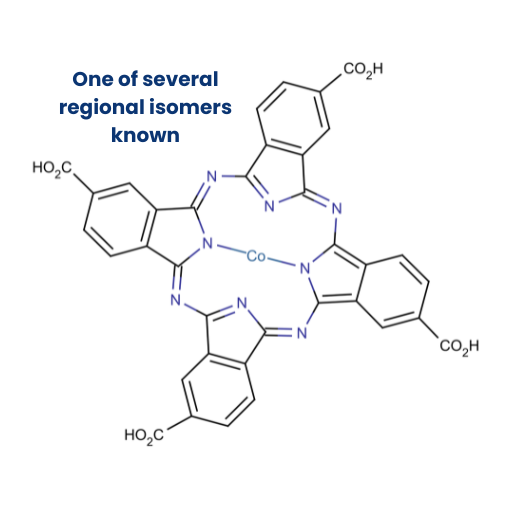
Name: Co(II) tetracarboxyl phthalocyanine
Molecular Formula: C36H16N8O8Co
CAS#: None
SMILES: OC(=O)C1=CC2=C(C=C1)C1=N\C3=C4C=C(C=CC4=C4N3[Co]N3\C(=N/C2=N/1)C1=C(C=C(C=C1)C(O)=O)/C3=N/C1=N/C(=N\4)C2=C1C=CC(=C2)C(O)=O)C(O)=O
MDL#: None
Catalog#: P12497
Molecular weight: 747.51 g/mol
Other Names and Synonyms
- Cobalt(II) tetracarboxyphthalocyanine
- Cobalt tetracarboxyphthalocyanine
- Cobalt(II) phthalocyanine-2,9,16,23-tetracarboxylic acid
- Cobalt(II) phthalocyaninetetracarboxylic acid
- Cobalt tetra-4-carboxyphthalocyanine
- 2,9,16,23-Tetracarboxyphthalocyaninatocobalt(II)
- CoTCPc
- CoTcPc
- Co-TCPc
- CoTCPPc
Fields of Interest
Coordination chemistry, electrocatalysis, electrochemical sensing, biosensors, energy conversion, photocatalysis, environmental remediation, carbon materials, functional polymers, surface modification, and advanced materials research.
Background and Applications
Cobalt(II) 2,9,16,23-tetracarboxyphthalocyanine is a functionalized cobalt phthalocyanine containing four peripheral carboxylic acid groups. Its extended conjugated macrocyclic structure provides useful electronic and optical properties, while the central cobalt ion supports redox activity and catalytic electron-transfer reactions.
The carboxyl groups provide chemically accessible sites for covalent coupling, coordination, salt formation, and immobilization on functional materials. The compound may be incorporated into electrodes, carbon materials, polymers, metal oxides, nanoparticles, and other solid supports through surface adsorption, coordination interactions, or coupling reactions.
The ionizable carboxyl groups may improve compatibility with polar or alkaline media compared with unsubstituted cobalt phthalocyanine. Solubility and aggregation behavior can vary with pH, solvent, counterion, concentration, and material form.
Applications include:
- Electrocatalysis and electrochemical oxidation
- Chemically modified electrodes
- Chemical sensors and biosensors
- Carbon-material and activated-carbon composites
- Polymer and conductive-polymer composites
- Metal-oxide and nanoparticle hybrid materials
- Photocatalytic degradation of organic contaminants
- Environmental remediation research
- Surface immobilization and covalent functionalization
- Energy-conversion and charge-transfer studies
Electrocatalysis and Sensing
Cobalt tetracarboxyphthalocyanine derivatives have been incorporated into carbon- and polymer-modified electrodes for the electrocatalytic oxidation and detection of electroactive compounds. The cobalt center can mediate redox reactions, while immobilization on conductive supports can improve electrode integration, catalyst handling, and electrochemical response.
Functional Materials
The peripheral carboxyl groups allow the compound to participate in coupling and coordination reactions used to construct hybrid materials. It may be attached to amine-functionalized carbon, biopolymers, conductive polymers, metal oxides, nanoparticles, and other functional surfaces. These systems are investigated as catalytic coatings, electrode modifiers, sensing materials, and recoverable heterogeneous catalysts.
Environmental Remediation
Supported cobalt tetracarboxyphthalocyanine materials have been studied for catalytic and light-assisted degradation of organic pollutants. Immobilization on carbon, polymeric, or magnetic supports may improve catalyst recovery and reuse while reducing loss of the molecular catalyst during treatment.
Research Considerations
This product does not have an assigned CAS number. Identification should therefore be based on the complete chemical name, molecular formula, substitution pattern, structure, and Frontier product number.
Tetrasubstituted phthalocyanines may exist as regioisomeric mixtures depending on the synthetic route. Product performance can also vary with isomer composition, aggregation, pH, counterion, solvent, catalyst loading, and immobilization method. Consult the product specification and analytical documentation for information applicable to the supplied material.
Appearance: Green solid
Purity: >95%
Storage: room temperature
Solubility: polar organic solvents such as dimethyl sulfoxide (DMSO) and dimethylformamide (DMF)
Literature:
- de la Torre, G., Claessens, C. G., & Torres, T. (2007). Phthalocyanines: Old dyes, new materials. Putting color in nanotechnology. Chemical Communications, (20), 2000-2015
- Kadish, K. M., Smith, K. M., & Guilard, R. (Eds.). (2003). The Porphyrin Handbook, Volume 17: Phthalocyanines—Properties and Materials. Academic Press.
- Leznoff, C. C., & Lever, A. B. P. (Eds.). (1989). Phthalocyanines: Properties and Applications (Vol. 1). VCH Publishers.
- Moyo, P.; Mugadza, T.; Mehlana, G.; Guyo, U. Synthesis and characterization of activated carbon-ethylenediamine-cobalt(II) tetracarboxyphthalocyanine conjugate for catalytic oxidation of ascorbic acid. Research on Chemical Intermediates. 2016, 42, 6511-6529. DOI: 10.1007/s11164-016-2477-z.
- Chen, C.; Ma, Z.; Zhou, S.; Li, T.; et al. Cobalt-tetracarboxyl-phthalocyanine linked with Fe3O4/chitosan microspheres: efficient catalyst for dye degradation. Catalysis Letters. 2017, 147, 2399-2409. DOI: 10.1007/s10562-017-2149-7