
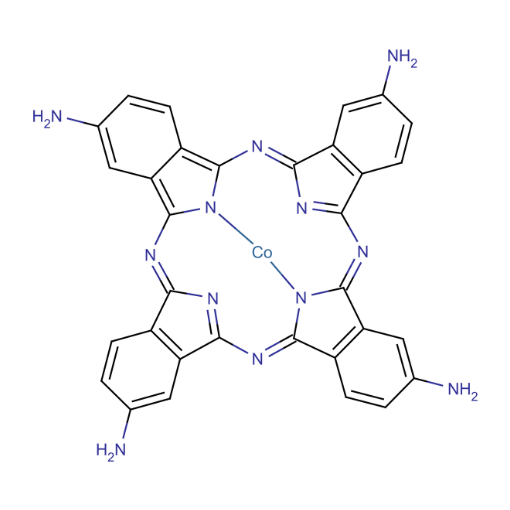
Name: Cobalt(II) 1,8,15,22-Tetraaminophthalocyanine (CoTAPc)
Molecular Formula: C₃₂H₂₀CoN₁₂
CAS#: 77135-78-5
SMILES: NC1=CC2=C(C=C1)C1=N\C3=C4C=C(N)C=CC4=C4/N=C5\N=C(\N=C6/N([Co]N34)\C(=N/C2=N/1)C1=C6C=C(N)C=C1)C1=C5C=C(N)C=C1
MDL#:
Catalog#: P10701
Molecular weight: 631.51 g/mol
Other Names and Synonyms
- Cobalt(II) 1,8,15,22-tetraaminophthalocyanine
- Cobalt(II) 1,8,15,22-tetra(amino)phthalocyanine
- Cobalt(II) tetraaminophthalocyanine
- Cobalt tetraaminophthalocyanine
- Cobalt tetraamino phthalocyanine
- Tetraaminocobalt(II) phthalocyanine
- Cobalt tetra-3-aminophthalocyanine
- CoTAPc
- Co(II)TAPc
- Co-TAPc
Fields of Interest
Electrocatalysis, carbon dioxide reduction, oxygen reduction, fuel-cell research, energy conversion and storage, electrochemical sensing, biosensors, environmental remediation, conductive polymers, functional coatings, carbon nanomaterials, nanotechnology, photocatalysis, and advanced materials research.
Background
Cobalt(II) 1,8,15,22-tetraaminophthalocyanine, commonly abbreviated CoTAPc, is a transition-metal phthalocyanine containing a cobalt(II) ion coordinated within an extended, conjugated macrocyclic ligand. Four peripheral amino groups provide chemically accessible sites for electropolymerization, covalent attachment, surface immobilization, and incorporation into hybrid materials.
The conjugated phthalocyanine framework supports electronic and redox activity, while the cobalt center can participate in catalytic electron-transfer processes. The amino substituents also allow CoTAPc to be coupled to electrodes, carbon nanotubes, graphene-derived materials, nanoparticles, polymers, and other functional surfaces. These characteristics make CoTAPc useful as both a molecular electrocatalyst and a building block for supported or polymeric catalytic materials.
Applications
Electrocatalysis and Oxygen Reduction
CoTAPc has been studied as an electrocatalyst for oxygen-reduction reactions on carbon and glassy-carbon electrodes. It may be deposited as a molecular layer or electropolymerized to form poly(CoTAPc) films. These modified electrodes are investigated for oxygen reduction, fuel-cell research, electrochemical energy conversion, and the development of durable catalytic electrode coatings.
Carbon Dioxide Reduction
Cobalt phthalocyanines are an important class of molecular catalysts for electrochemical and photocatalytic carbon dioxide reduction. Amino-substituted CoTAPc has been investigated alone and in combination with carbon nanotubes and other conductive supports for CO₂ conversion, including research directed toward carbon monoxide and methanol formation. The peripheral amino groups can assist material integration, catalyst dispersion, and electronic interaction with the supporting substrate.
Electrochemical Sensors and Biosensors
Electropolymerized CoTAPc films can facilitate the oxidation or reduction of electroactive analytes and are used in the design of chemically modified electrodes. Research applications include electrochemical detection of pharmaceutical compounds, sulfur-containing molecules, thiols, environmental contaminants, and biological analytes such as glutathione.
CoTAPc may function as both an electrochemical mediator and a surface-active component, while the amino groups provide attachment points for forming organized layers or coupling the phthalocyanine to functionalized electrode surfaces.
Carbon Nanotube and Graphene Composites
The aromatic phthalocyanine ring can interact with graphitic materials through π–π interactions, while the amino groups provide additional possibilities for covalent linkage or interfacial assembly. CoTAPc has therefore been investigated in composites containing single-walled or multiwalled carbon nanotubes, graphene-related materials, carbon fibers, and mesoporous carbon.
These hybrid materials are of interest for improving catalyst dispersion, charge transfer, surface area, electrode stability, and analyte response.
Electropolymerized and Conductive Films
The peripheral amino groups enable electrochemical polymerization of CoTAPc on conductive substrates. Poly(CoTAPc) films are studied as redox-active and catalytically active coatings for modified electrodes, electrochemical sensors, oxidation and reduction reactions, and electrical or spectroelectrochemical investigations.
Film thickness, electrode substrate, supporting electrolyte, and pH can influence the electrochemical behavior of these materials.
Environmental Remediation
Supported CoTAPc catalysts have been investigated for the electrochemical or peroxide-assisted degradation of dyes, phenolic compounds, pharmaceuticals, and other organic contaminants. Immobilization on carbon fibers, graphene-based materials, or polymeric supports can facilitate catalyst recovery, improve material handling, and reduce loss of the molecular catalyst during treatment.
Photocatalysis and Hybrid Functional Materials
CoTAPc may be incorporated into semiconductor, nanocrystal, and carbon-based hybrid systems for photocatalytic charge-transfer studies. Its conjugated macrocycle can contribute visible-light absorption and electron-transfer functionality, while its amino groups allow the molecule to serve as a linker or interfacial component in organized nanostructures.
Polymer and Surface Functionalization
The four amino groups make CoTAPc a useful precursor for covalent incorporation into polymers, amide-linked materials, surface coatings, and cross-linked networks. It may be attached to carboxyl-functionalized surfaces, carbon materials, nanoparticles, or polymer matrices to produce immobilized catalytic and electronically active materials.
Research Considerations
The exact substitution pattern and isomer composition should be confirmed using the product specification and analytical data supplied with the material. Tetrasubstituted phthalocyanines are sometimes supplied or described as regioisomeric mixtures, and numbering conventions may differ between supplier records and scientific publications.
Performance in an electrochemical or catalytic system will depend on variables such as catalyst loading, aggregation, electrode composition, immobilization method, film thickness, electrolyte, pH, supporting material, and applied potential. Application suitability should therefore be established experimentally for the intended research system.
Appearance: Blue green solid
Purity: >95%
Storage: room temperature
Solubility: dimethylformamide (DMF) and dimethyl sulfoxide (DMSO)
Literature:
- Phthalocyanines: Properties and Applications. Leznoff, C. C., & Lever, A. B. P. (Eds.). (1996). Phthalocyanines: Properties and Applications (Vol. 4). VCH Publishers.
- The Porphyrin Handbook. Kadish, K. M., Smith, K. M., & Guilard, R. (Eds.). (2003). The Porphyrin Handbook, Vol. 17. Academic Press.
- International Union of Pure and Applied Chemistry. IUPAC. Compendium of Chemical Terminology (Gold Book). Definitions and terminology related to coordination compounds and phthalocyanines.
- Hong, X.-P.; Zhu, Y.; Zhang, Y.-Z. Electrocatalytic response of poly(cobalt tetraaminophthalocyanine)/multi-walled carbon nanotubes-Nafion modified electrode toward sulfadiazine in urine. Journal of Zhejiang University Science B. 2012, 13, 538-548. DOI: 10.1631/jzus.B1100337.
- Nyoni, S.; Mugadza, T.; Nyokong, T. Improved L-cysteine electrocatalysis through a sequential drop-dry technique using multi-walled carbon nanotubes and cobalt tetraaminophthalocyanine conjugates. Electrochimica Acta. 2014, 128, 32-40.
- Electropolymerization of cobalt tetraamino-phthalocyanine at reduced graphene oxide for electrochemical sensing. RSC Advances. 2016, 6, 38463-38472. DOI: 10.1039/C6RA01851C.
- Building a stable cationic molecule/electrode interface for highly efficient CO2 electroreduction. Energy and Environmental Science. 2021, 14, 483-493.