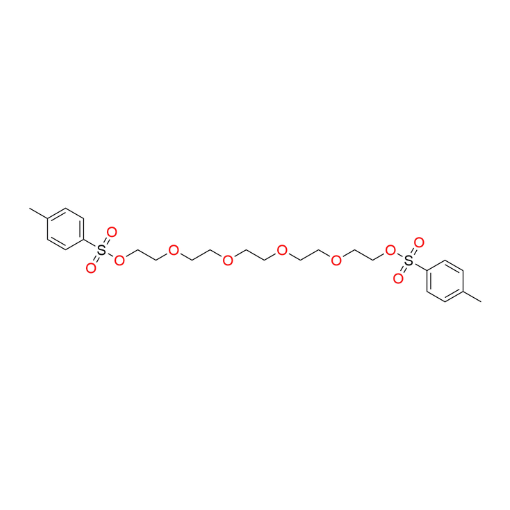
3,6,9,12-Tetraoxatetradecane-1,14-diol, 1,14-bis(4-methylbenzenesulfonate)
Molecular Formula: C24H34O10S2
CAS#: 41024-91-3
SMILES: O=S(C1=CC=C(C)C=C1)(OCCOCCOCCOCCOCCOS(C2=CC=C(C)C=C2)(=O)=O)=O
MDL#: MFCD00012204
Catalog#: AMTGC541-TM20
Molecular weight: 546.65 g/mol
Appearance: Colorless liquid
Purity: 97.1%
Storage: Long-term storage in a fridge at 2-8°C
Solubility: Dichloromethane, Chloroform, Methanol
Other names:
- penta(ethylene glycol) bis(p-toluenesulfonate)
- pentaethylene glycol di(p-toluenesulfonate)
- Pentaethylene glycol ditosylate
- Bis-Tos-PEG5
- Tos-PEG5-Tos
- 3,6,9,12-Tetraoxatetradecane-1,14-diyl ditosylate
Fields of Interest
PEG linker synthesis, organic synthesis, medicinal chemistry, chemical biology, PROTAC linker development, supramolecular chemistry, crown ether synthesis, polymer chemistry, materials science, molecular crosslinking, specialty chemical synthesis
Background
Pentaethylene glycol di(p-toluenesulfonate) (CAS 41024-91-3) is a homobifunctional PEG-based synthetic linker consisting of a flexible pentaethylene glycol (PEG5) chain terminated at both ends with tosylate (p-toluenesulfonate) groups. The oligoethylene glycol backbone provides molecular flexibility and hydrophilic character, while the terminal tosylates act as effective leaving groups for nucleophilic substitution.
Rather than serving as a final conjugation reagent itself, Pentaethylene glycol ditosylate is particularly valuable as a synthetic intermediate for preparing functionalized PEG derivatives. Both terminal tosylates can be displaced by suitable nucleophiles, providing a versatile route to symmetrical bifunctional PEG linkers with application-specific terminal groups.
Applications
Pentaethylene glycol di(p-toluenesulfonate) is useful in PEG linker synthesis, organic synthesis, medicinal chemistry, supramolecular chemistry, polymer modification, materials science, and bioconjugation reagent development. Its two activated tosylate termini can undergo nucleophilic substitution, enabling the preparation of PEG derivatives bearing azide, amine, thiol, halide, and other functional groups.
The defined PEG5 spacer also makes this compound useful for constructing bifunctional crosslinkers, macrocycles, crown ethers, and other molecular architectures where controlled spacing and flexibility are important. Published and commercial references report its use in the preparation of crown ethers and calixarene derivatives, while it is also used as a PEG-based building block in PROTAC linker synthesis.
Literature:
- Bioorganic and Medicinal Chemistry, 2007, vol. 15, # 14, p. 4841 – 4856
- Journal of Organic Chemistry, 1999, vol. 64, # 18, p. 6870 – 6873
- Chemical Communications, 2025, vol. 61, # 14, p. 3001 – 3004