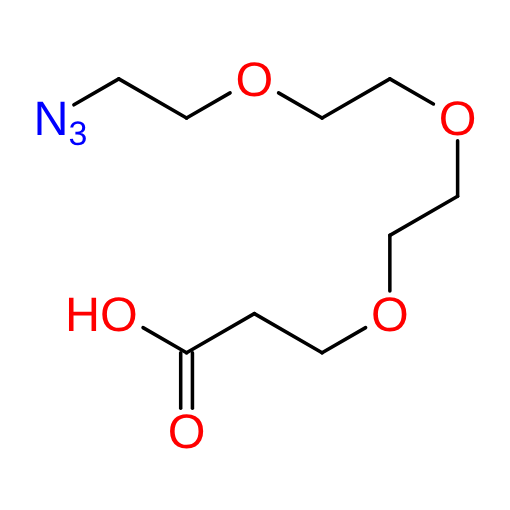
3-[2-[2-(2-Azidoethoxy)ethoxy]ethoxy]propanoic acid (98%)
Molecular Formula: C9H17N3O5
CAS#: 1056024-94-2
SMILES: OC(CCOCCOCCOCCN=[N+]=[N-])=O
MDL#: MFCD23726617
Catalog#: AMTGC715-PA20
Molecular weight: 247.25 g/mol
Appearance: Yellow Liquid
Purity: 98%
Storage: No special considerations
Solubility: Dichloromethane, Chloroform, Methanol
Other names:
- N3-PEG3-CH2CH2CO2H
- Azido-dPEG4-acid
- 12-Azido-4,7,10-trioxadodecanoic acid
Fields of Interest:
Functionalized PEGs, azido PEGs, acid PEGs, click chemistry, bioconjugation, medicinal chemistry, drug discovery, PROTAC linker synthesis, targeted protein degradation, antibody-drug conjugates, chemical biology, molecular probe development, nanoparticle functionalization, custom linker synthesis
Background
3-[2-[2-(2-Azidoethoxy)ethoxy]ethoxy]propanoic acid (CAS 1056024-94-2) is a heterobifunctional, discrete PEG linker containing a terminal azide and carboxylic acid separated by a flexible triethylene glycol-derived spacer. The combination of these two chemically distinct functionalities makes the compound useful for sequential and orthogonal conjugation strategies. Frontier’s AMT catalog lists the compound under its systematic name, while Azido-PEG3-acid and N3-PEG3-CH₂CH₂COOH are commonly used shorthand names.
The terminal azide provides a compact bioorthogonal handle for copper-catalyzed azide–alkyne cycloaddition (CuAAC) with terminal alkynes and strain-promoted azide–alkyne cycloaddition (SPAAC) with strained cyclooctynes such as DBCO or BCN. The carboxylic acid provides complementary functionality for coupling to primary amines after activation with common coupling reagents, enabling formation of stable amide bonds.
This combination allows one end of the linker to be attached through conventional amide chemistry while retaining the azide for subsequent click conjugation, or vice versa when the synthetic sequence permits. The defined oligoethylene glycol spacer contributes flexibility and hydrophilic character while providing a reproducible molecular length compared with polydisperse PEG materials.
The compound is also available in a tert-butyl-protected acid form, CAS 252881-73-5, which Frontier’s AMT catalog lists directly after CAS 1056024-94-2. The protected derivative can be useful when the carboxylic acid must remain masked during earlier synthetic transformations.
Applications
Azido-PEG3-acid is particularly useful as a two-stage linker for modular molecular assembly. The carboxylic acid can be activated and coupled with an amine-containing drug, ligand, peptide, fluorophore, or other molecular component, leaving the terminal azide available for subsequent click chemistry. This makes the reagent valuable in bioconjugation and medicinal chemistry workflows requiring two complementary reaction handles.
The compound has direct peer-reviewed precedent in drug-conjugate development. Azido-PEG3-acid, specifically identified as CAS 1056024-94-2, was used to prepare a PEG-modified erlotinib intermediate through CuAAC. The resulting intermediate was then conjugated with curcumin to produce an amphiphilic curcumin–erlotinib conjugate capable of self-assembling into nanoparticles for cancer-targeting research.
CAS 1056024-94-2 also has direct precedent in nanoparticle surface functionalization and targeted delivery systems. The compound has been used as a synthetic intermediate in PEG-containing architectures for functionalizing gold nanoparticles with RGD-derived targeting ligands. This illustrates the value of the azide/carboxylic-acid combination for connecting targeting groups to nanoscale materials while maintaining controlled molecular spacing.
In chemical biology and molecular probe development, Azido-PEG3-acid can provide a short hydrophilic spacer between a recognition element and a reactive or reporter group. Its azide functionality is particularly valuable for introducing additional components through click chemistry after an initial amide coupling step. Related probe research has used this exact compound in the synthesis of azide-containing activity-based probes for detecting bacterial enzymes.
The compound is additionally used as a building block in PROTAC and antibody-drug conjugate linker development. Commercial biochemical references identify N3-PEG3-CH₂CH₂COOH as a PEG-based linker used in PROTAC synthesis and as a non-cleavable PEG unit for ADC construction. Its defined spacer length makes it particularly useful when researchers are systematically evaluating how linker composition and distance influence the behavior of a larger conjugate.
Literature:
- Maggi, V.; Bianchini, F.; Portioli, E.; Peppicelli, S.; Lulli, M.; Bani, D.; Del Sole, R.; Zanardi, F.; Sartori, A.; Fiammengo, R. “Gold Nanoparticles Functionalized with RGD-Semipeptides: A Simple yet Highly Effective Targeting System for αVβ3 Integrins.” Chem. Eur. J. 2018, 24, 12093–12100. DOI: 10.1002/chem.201801823.
- This study provides exact-compound synthetic precedent for 3-[2-[2-(2-azidoethoxy)ethoxy]ethoxy]propanoic acid. The azido-PEG acid was incorporated into the synthetic strategy used to prepare precisely functionalized gold nanoparticles bearing RGD-derived targeting ligands. The resulting materials showed selective αVβ3 integrin recognition, demonstrating the utility of defined azido-PEG linkers in targeted nanoparticle and biomaterials research.
- Luijkx, Y. M. C. A.; Henselijn, A. J.; Bosman, G. P.; Cramer, D. A. T.; Giesbers, K. C. A. P.; van ’t Veld, E. M.; Boons, G.-J.; Heck, A. J. R.; Reiding, K. R.; Strijbis, K.; Wennekes, T. “Detection of Bacterial α-L-Fucosidases with an Ortho-Quinone Methide-Based Probe and Mapping of the Probe-Protein Adducts.” Molecules 2022, 27, 1615. DOI: 10.3390/molecules27051615.
- This work uses the exact azido-PEG acid structure in the synthesis of an activity-based chemical probe designed to detect bacterial α-L-fucosidases. The resulting probe incorporated an azide mini-tag for downstream chemical analysis and enabled detection of both retaining and inverting fucosidases, supporting the use of this linker architecture in chemical biology, proteomics, and molecular probe development.
- Carrier-Free Nano-Assembly of Curcumin–Erlotinib Conjugate for Cancer Targeted Therapy.
- This peer-reviewed study specifically identifies Azido-PEG3-acid (CAS 1056024-94-2) in its experimental section. The reagent was reacted with erlotinib through CuAAC to prepare a PEG-modified erlotinib intermediate, which was subsequently coupled with curcumin. The resulting amphiphilic conjugate self-assembled into nanoparticles, providing direct exact-compound precedent for this linker in drug conjugation and nanomedicine research.