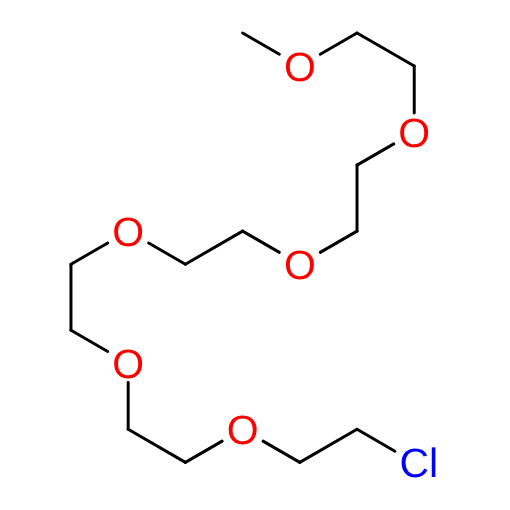
2,5,8,11,14,17-Hexaoxanonadecan-19-chloride (98%)
Molecular Formula: C13H27ClO6
CAS#: 113694-55-6
SMILES: COCCOCCOCCOCCOCCOCCCl
MDL#: MFCD32214891
Catalog#: AMTGC328-HC17
Molecular weight: 314.80 g/mol
Appearance: colorless liquid
Purity: 98%
Storage: Room Temperature
Solubility: Dichloromethane, Chloroform, Methanol
Other names:
- Me-PEG5-CH2CH2Cl
- Methyl hexaethylene glycol chloride
- m-PEG6-Cl
- mPEG6-Cl
- Methoxy-PEG6-chloride
- 19-Chloro-2,5,8,11,14,17-hexaoxanonadecane
Fields of Interest:
Functionalized PEGs, PEG linker synthesis, organic synthesis, medicinal chemistry, drug discovery, bioconjugation reagent synthesis, PROTAC linker synthesis, polymer chemistry, materials science, surface functionalization, specialty chemical synthesis
Background
19-Chloro-2,5,8,11,14,17-hexaoxanonadecane (CAS 113694-55-6) is a monofunctional, discrete oligoethylene glycol derivative commonly referred to as m-PEG6-Cl. The molecule contains a defined PEG6 chain terminated at one end by a relatively inert methoxy group and at the other by a primary chloroethyl group. This combination provides a flexible, hydrophilic oligoethylene glycol spacer together with a terminal functionality suitable for further chemical modification.
Unlike heterobifunctional PEG linkers that contain two independently reactive termini, m-PEG6-Cl is designed primarily for single-point PEG incorporation or further derivatization. The methoxy terminus effectively caps one end of the molecule, while the terminal alkyl chloride provides a site for nucleophilic substitution. The defined PEG6 structure also distinguishes it from polydisperse polymeric PEG materials: it provides a specific molecular length and composition useful where reproducible molecular spacing is important. The identity of CAS 113694-55-6 as m-PEG6-Cl and its PEG6 structure are independently reported in commercial chemical databases and PEG-linker catalogs.
Applications
The primary value of m-PEG6-Cl is as a synthetic intermediate for introducing a defined methoxy-terminated PEG6 chain into other molecules. The terminal chloride can undergo nucleophilic substitution, allowing conversion to other functionalized PEG derivatives or direct attachment of the PEG chain to suitable nucleophiles. Depending on the reaction system, this makes the compound useful as a precursor to PEG derivatives bearing amine, azide, thiol, ether, or other terminal functionality.
In medicinal chemistry and drug-discovery research, defined oligoethylene glycol chains are frequently incorporated into molecular designs to provide controlled spacing and alter properties such as polarity and aqueous compatibility. m-PEG6-Cl provides a relatively long discrete spacer while leaving only one reactive terminus, making it useful when a methoxy-capped PEG segment rather than a bifunctional crosslinker is desired.
The compound can also serve as a building block in linker synthesis, polymer and materials chemistry, surface modification, and specialty chemical synthesis. Importantly, the chloride itself should be regarded as a synthetic precursor functionality rather than a bioorthogonal conjugation handle. Conversion of the chloride to groups such as azide or amine can produce derivatives better suited to click chemistry, amide coupling, or other bioconjugation strategies.
CAS 113694-55-6 also has documented precedent as a chain-extension reagent: methyl hexaethylene glycol chloride has been reacted with tetraethylene glycol to prepare decaethylene glycol monomethyl ether, demonstrating its utility for constructing longer, discrete oligoethylene glycol chains.
Literature:
- Patent: GLAXO GROUP – US6355646, 2002, B1
The following literature therefore supports the discrete oligoethylene glycol chemistry and applications relevant to this compound rather than claiming direct experimental use of CAS 113694-55-6.
- Mikesell, L.; Eriyagama, D. N. A. M.; Yin, Y.; Lu, B.-Y.; Fang, S. “Stepwise PEG Synthesis Featuring Deprotection and Coupling in One Pot.” Beilstein Journal of Organic Chemistry 2021, 17, 2976–2982. DOI: 10.3762/bjoc.17.207.
- This study describes controlled stepwise synthesis of monodisperse PEGs and PEG derivatives using coupling strategies based on Williamson ether formation. It provides useful literature support for the role of discrete functionalized PEG building blocks in constructing longer, structurally defined PEG chains.
- Gudipati, V.; Curran, D. P.; Wilcox, C. S. “Solution-Phase Parallel Synthesis with Oligoethylene Glycol Sorting Tags. Preparation of All Four Stereoisomers of the Hydroxybutenolide Fragment of Murisolin and Related Acetogenins.” Journal of Organic Chemistry 2006, 71, 3599–3607. DOI: 10.1021/jo060217x.
- The authors use defined oligoethylene glycol chains as molecular tags in multistep organic synthesis, illustrating the synthetic versatility of discrete OEG structures and their compatibility with complex small-molecule synthesis.
- Breiner, L. M.; Slowinski, R. P.; Lowell, A. N. “Highly Active Oligoethylene Glycol Pleuromutilins via Systematic Linker Synthesis/One-Pot Attachment and a Microscale Solubility Method.” Journal of Organic Chemistry 2025, 90, 919–924. DOI: 10.1021/acs.joc.4c02683.
- This study systematically evaluates defined oligoethylene glycol linkers of varying lengths in medicinal-chemistry derivatives, illustrating how discrete OEG chains can be incorporated as linkers and used to tune molecular properties. This is class-level rather than compound-specific support.