
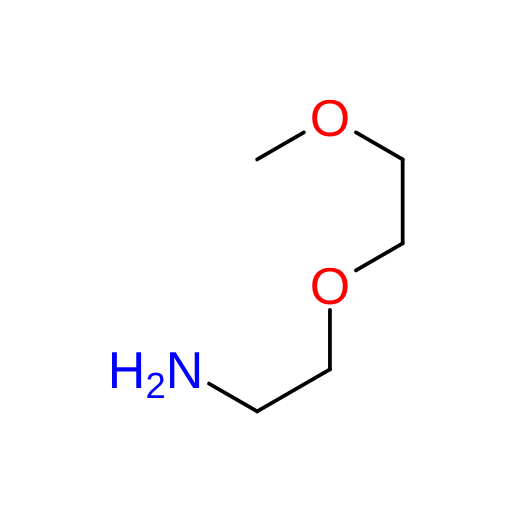
2-(2-Methoxyethoxy)ethanamine (99.8%)
Molecular Formula: C5H13NO2
CAS#: 31576-51-9
SMILES: NCCOCCOC
MDL#: MFCD09032941
Catalog#: AMTGC284-MA17
Molecular weight: 119.16 g/mol
Appearance: Pale yellow liquid
Purity: 99.8%
Storage: Room Temperature
Solubility: Dichloromethane, Chloroform, Methanol
Other names:
- Me-PEG-CH2CH2NH2
- Me-PEG2-NH2
- Me-PEG2-Amine
- Di(ethylene glycol) methyl ether amine
Fields of Interest:
PEG Chemistry, Organic Synthesis, Amide Coupling, Molecular Conjugation, Peptoid Research
Background
2-(2-Methoxyethoxy)ethanamine (m-PEG2-amine, CAS 31576-51-9) is a short, methoxy-capped polyethylene glycol (PEG) building block used to introduce a defined oligoether substituent through primary-amine chemistry. Its structure contains two ether oxygen atoms, a terminal primary amine, and a methyl ether cap. This combination provides a compact, flexible, polar chain with a single amine attachment site.
The primary amine can react with activated carboxylic acids, including N-hydroxysuccinimide (NHS) esters, to form amide bonds. The methoxy terminus remains capped during typical amide-coupling reactions, allowing the oligoether chain to be attached through the amino end. As a discrete compound with a fixed chain length, m-PEG2-amine supports the preparation of structurally defined derivatives. Its value in molecular design comes from the combination of accessible amine reactivity and a short ether-containing substituent; the properties of the finished conjugate depend on its complete structure.
Applications
The principal applications of m-PEG2-amine follow from its primary amine and defined oligoether chain.
Amide coupling and molecular conjugation: Reaction with an activated carboxyl-containing molecule installs the methoxy-capped PEG segment through an amide linkage. This chemistry provides a route to modified small molecules, peptide derivatives, and other research conjugates where a short terminal oligoether group is desired.
Defined PEG substitution in analogue synthesis: m-PEG2-amine can serve as an amine building block when preparing related compounds with different terminal substituents. Its fixed chain length allows researchers to introduce a specific ether-containing side chain and investigate how that structural change affects properties such as solubility or assay behavior. Such effects require evaluation in the resulting compounds.
Peptoid building-block research: Primary amines introduce side chains during submonomer synthesis of peptoids, or N-substituted glycine oligomers. Based on this established chemistry, m-PEG2-amine is a candidate for introducing a methoxy-oligoether side chain into peptoid sequences. This application is supported by the general synthesis method; the selected literature does not establish performance for this exact amine.
Literature:
- Journal of Organic Chemistry, 2011, vol. 76, # 6, p. 1683 – 1691
- Inorganica Chimica Acta, 2016, vol. 452, p. 159 – 169
- Bioorganic and Medicinal Chemistry Letters, 2003, vol. 13, # 7, p. 1381 – 1384
- Montalbetti, C. A. G. N.; Falque, V. “Amide bond formation and peptide coupling.” Tetrahedron 2005, 61, 10827–10852. https://doi.org/10.1016/j.tet.2005.08.031
- Reviews carboxylic acid activation and amine coupling methods relevant to attaching m-PEG2-amine through an amide bond; this is general methodology rather than an exact-compound study.
- Zuckermann, R. N.; Kerr, J. M.; Kent, S. B. H.; Moos, W. H. “Efficient method for the preparation of peptoids [oligo(N-substituted glycines)] by submonomer solid-phase synthesis.” Journal of the American Chemical Society 1992, 114, 10646–10647. https://doi.org/10.1021/ja00052a076
- Establishes primary-amine incorporation in peptoid synthesis, providing the methodological basis for evaluating oligoether amines such as m-PEG2-amine as submonomers.