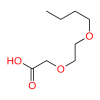
2-(2-Butoxyethoxy)acetic acid (>99%)
Molecular Formula: C8H16O4
CAS#: 82941-26-2
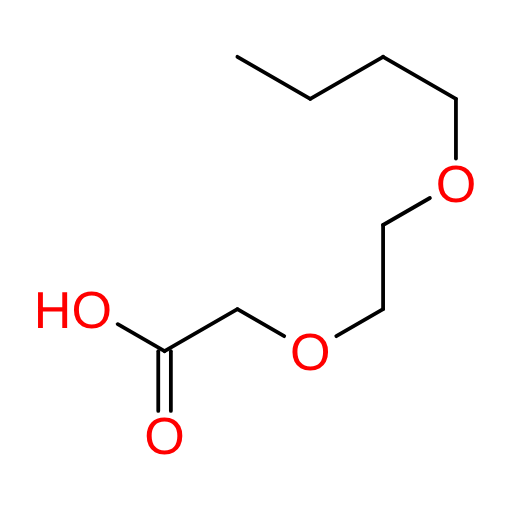
SMILES: CCCCOCCOCC(O)=O
MDL#: MFCD01105178
Catalog#: AMTGC1548-BA25
Molecular weight: 176.21 g/mol
Appearance: Colorless Liquid
Purity: >99%
Storage: No Special Consideration
Solubility: Dichloromethane, Chloroform, Methanol
Other names:
- 3,6-Dioxadecanoic acid
Fields of Interest
Ether carboxylic acids, glycol ether derivatives, organic synthesis, surfactant chemistry, emulsifiers, lubricant additives, materials chemistry, formulation research, functional building blocks
Background
2-(2-Butoxyethoxy)acetic acid (CAS 82941-26-2) is an ether-containing carboxylic acid composed of an n-butyl group, two ether oxygens, and a terminal acetic acid group.
Structurally, the molecule can be represented as:
CH3(CH2)3–O–CH2CH2–O–CH2–COOH
This structure combines a relatively hydrophobic butyl terminus with an ether-rich segment and polar carboxylic acid. As a result, the compound has an amphiphilic character that distinguishes it from both conventional fatty acids and longer PEG-based carboxylic acids.
The terminal carboxylic acid provides the primary synthetic handle. It can potentially be converted into salts, esters, amides, or other carboxylic-acid derivatives using standard organic transformations. The ether groups provide additional polarity and flexibility without introducing another strongly reactive terminus.
Although its two ether oxygens give it some structural similarity to short oligoethylene glycol compounds, CAS 82941-26-2 is better described as a glycol ether carboxylic acid or ether carboxylic acid rather than a conventional functionalized PEG linker. This distinction is useful for accurately positioning the product for researchers searching for amphiphilic acids, surfactant intermediates, and specialty organic building blocks.
Applications
2-(2-Butoxyethoxy)acetic acid is relevant to surfactant, emulsifier, and formulation chemistry because its molecular structure combines a hydrophobic butyl group with polar ether and carboxylic-acid functionality. The U.S. EPA has specifically documented its intended use as an emulsifier for metalworking fluid. EPA records also identify potential applications associated with lubricant base stocks, bonding-material coatings, fire-extinguisher surfactants, and materials used in electronic-component manufacturing.
The terminal carboxylic acid also makes the compound useful as an organic synthesis building block. Conversion of the acid to esters, amides, salts, or other derivatives provides a route to molecules that retain the butoxyethoxy segment while introducing additional functionality through the carboxyl terminus.
Its combination of a short hydrophobic alkyl chain and ether-containing polar segment can also be useful in materials and interfacial chemistry, particularly when researchers require an amphiphilic building block considerably smaller than conventional polymeric surfactants or PEG derivatives.
CAS 82941-26-2 is additionally relevant to the chemistry and metabolism of diethylene glycol monobutyl ether derivatives. It has been identified as a major urinary metabolite following exposure to diethylene glycol monobutyl ether acetate, providing well-established analytical and toxicological literature precedent for the exact compound.
Literature:
- Deisinger, P. J.; Guest, D. “Metabolic Studies with Diethylene Glycol Monobutyl Ether Acetate (DGBA) in the Rat.” Xenobiotica 1989, 19, 981–989. DOI: 10.3109/00498258909043155.
- This study provides direct exact-compound evidence for 2-(2-butoxyethoxy)acetic acid. Following administration of diethylene glycol monobutyl ether acetate, the researchers identified 2-(2-butoxyethoxy)acetic acid as the major urinary metabolite. The study provides useful information on the formation and biological disposition of this glycol ether carboxylic acid.