
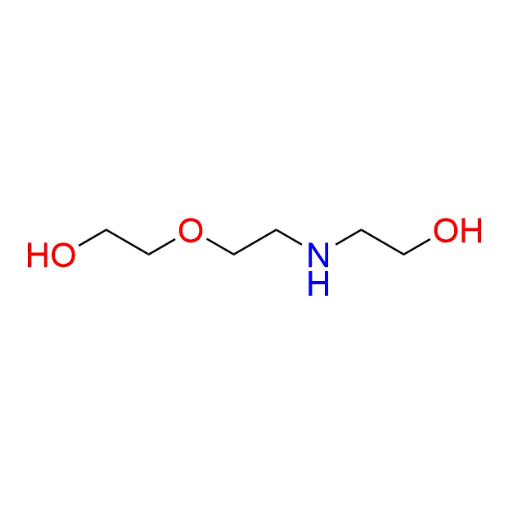
Name: 2-((2-(2-hydroxyethoxy)ethyl)amino)ethan-1-ol
Molecular Formula: C6H15NO3
CAS#: 5038-17-5
SMILES: OCCOCCNCCO
MDL#: MFCD03551931
Catalog#: AMTGC531-HE20
Molecular weight: 149.19 g/mol
Other names:
- N-(2-Hydroxyethyl)-2-(2-hydroxyethoxy)ethylamine
- Secondary amine PEG diol
- Amino alcohol PEG intermediate
Fields of Interest: bioconjugation, materials science, polymer chemistry, and specialty chemical synthesis
Background & Applications:
Background
2-((2-(2-Hydroxyethoxy)ethyl)amino)ethan-1-ol is a compact, heterobifunctional amino alcohol PEG derivative featuring a central secondary amine flanked by two hydroxyethyl-containing ether chains. Often viewed as an amino-functionalized diethylene glycol derivative, this molecule combines the hydrophilicity and flexibility of short PEG-like spacers with the reactivity of both a secondary amine and two terminal hydroxyl groups. The hydroxyl functionalities can be derivatized through esterification, etherification, or activation chemistry, while the secondary amine provides a versatile site for alkylation, acylation, and conjugation reactions. As a multifunctional intermediate, this compound serves as a valuable building block within a broad portfolio of functionalized PEGs, amino alcohols, and linker technologies designed for modular molecular assembly and specialty synthesis.
Applications
2-((2-(2-Hydroxyethoxy)ethyl)amino)ethan-1-ol is commonly used in bioconjugation, materials science, polymer chemistry, and specialty chemical synthesis applications where hydrophilicity and multifunctional reactivity are desired. Typical uses include preparation of PEG-based linkers, synthesis of ionizable intermediates, incorporation into surfactants and specialty polymers, and construction of multifunctional molecules through sequential modification of the hydroxyl and amine groups. The combination of two hydroxyl groups and a secondary amine enables flexible synthetic routes and orthogonal functionalization strategies. As part of a robust functionalized PEG product line, this compound supports modular design approaches in pharmaceutical research, biomaterials development, and advanced materials synthesis.
Appearance: Colorless to pale yellow liquid
Purity: 97%
Storage: Room Temperature
Solubility: Dichloromethane, Chloroform, Methanol
Literature:
- Bulletin of the Chemical Society of Japan, 1983, vol. 56, # 1, p. 212 – 218
- European Journal of Organic Chemistry, 2002, # 22, p. 3768 – 3778
- European Journal of Organic Chemistry, 2002, # 22, p. 3768 – 3778