
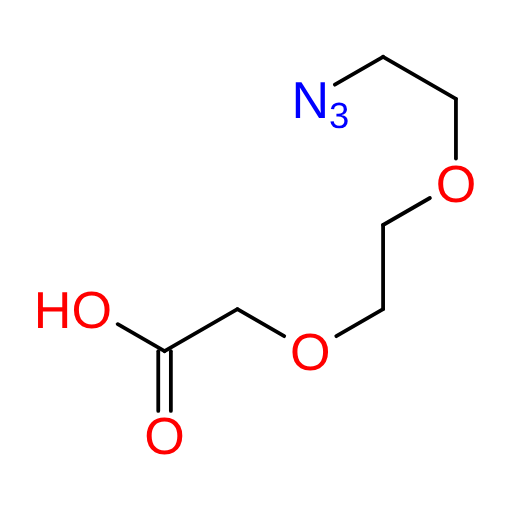
2-(2-(2-Azidoethoxy)ethoxy)acetic acid (95%)
Molecular Formula: C6H11N3O4
CAS#: 882518-90-3
SMILES: OC(COCCOCCN=[N+]=[N-])=O
MDL#: MFCD24395877
Catalog#: AMTGC628-AA20
Molecular weight: 189.17 g/mol
Appearance: Dark colored Liquid
Purity: 95%
Storage: No special conditions
Solubility: Dichloromethane, Chloroform, Methanol
Other names:
- Azido-PEG2-CH2CO2H
- Azido-PEG2-acetic acid
- N3-PEG2-CH2COOH
Fields of Interest:
Functionalized PEGs, azido PEGs, acid PEGs, click chemistry, bioconjugation, medicinal chemistry, drug discovery, PROTAC linker synthesis, targeted protein degradation, chemical biology, oligonucleotide conjugation, molecular probe development, custom linker synthesis
Background
2-[2-(2-Azidoethoxy)ethoxy]acetic acid (CAS 882518-90-3) is a compact heterobifunctional PEG linker containing a terminal azide and a carboxylic acid separated by a defined diethylene glycol-derived spacer. Frontier’s AMT catalog lists the compound under this systematic name, while Azido-PEG2-CH₂COOH is a commonly used shorthand. Its molecular formula is C6H11N3O4 and molecular weight is 189.17 g/mol.
The two terminal groups provide complementary reaction pathways for orthogonal and sequential molecular assembly. The azide can undergo copper-catalyzed azide–alkyne cycloaddition (CuAAC) with terminal alkynes or strain-promoted azide–alkyne cycloaddition (SPAAC) with strained cyclooctynes such as DBCO and BCN. The carboxylic acid can independently be activated for coupling with primary amines to form stable amide bonds.
This combination makes Azido-PEG2-CH2COOH particularly useful when a short, defined spacer is needed between a click-reactive azide and an amine-reactive carboxyl group. Compared with longer PEG homologues, its compact PEG2 segment minimizes linker length while retaining ether oxygens that provide flexibility and hydrophilic character.
The compound is also the deprotected acid counterpart of tert-butyl 2-(2-(2-azidoethoxy)ethoxy)acetate (CAS 251564-45-1). Frontier’s AMT catalog lists the protected ester immediately alongside CAS 882518-90-3, providing complementary options for synthetic routes that either require a coupling-ready acid or a protected carboxyl functionality.
Applications
Azido-PEG2-CH2COOH is particularly useful for constructing heterobifunctional linkers and conjugates through a combination of click chemistry and amide coupling. The carboxylic acid can be activated using common peptide-coupling or carbodiimide chemistry and reacted with an amine-containing molecule, leaving the terminal azide available for subsequent CuAAC or SPAAC conjugation. Alternatively, click chemistry can be performed first when compatible with the remaining synthetic sequence.
There is direct peer-reviewed precedent for using the exact compound in oligonucleotide and nucleic-acid conjugation chemistry. In work on clickable m3G cap analogues, 2-[2-(2-azidoethoxy)ethoxy]acetic acid was activated with HBTU and coupled to an amino-functionalized oligoethylene glycol component. The resulting azido-containing intermediate was subsequently incorporated into a more complex nucleotide-derived structure. This demonstrates the compound’s value as a compact linker for combining amide-bond formation with downstream click functionality.
The exact compound has also been used in targeted protein degradation research. Research developing molecular degraders for G protein-coupled receptors reports preparation and characterization of 2-(2-(2-azidoethoxy)ethoxy)acetic acid as a PEG-based linker intermediate. Related work on α1A-adrenergic receptor degraders likewise synthesized this exact PEG2 acid as part of a series of azido-PEG carboxylic acids used to investigate linker length in PROTAC design.
In bioconjugation and chemical biology, the combination of a carboxylic acid and azide provides a straightforward route to installing a click-reactive PEG segment onto amine-containing peptides, proteins, probes, ligands, or other molecules. Once the acid has been coupled, the remaining azide can provide a second attachment point for dyes, affinity tags, targeting groups, or other alkyne/cyclooctyne-functionalized components.
The relatively short spacer is also useful in medicinal chemistry and molecular probe development when researchers want the synthetic versatility of a PEG linker without introducing a long flexible chain. Because both termini can participate in well-established coupling reactions, CAS 882518-90-3 provides a practical building block for modular synthesis of more complex functional molecules.
Literature:
- Ziemniak, M.; Strenkowska, M.; Kowalska, J.; Jemielity, J. “Potential Therapeutic Applications of RNA Cap Analogs.” Future Med. Chem. 2013, 5, 1141–1172. DOI: 10.4155/fmc.13.96.
- This work discusses chemically modified RNA cap structures and strategies for introducing functional groups into nucleotide-derived systems. Azido-functionalized oligoethylene glycol linkers such as 2-[2-(2-azidoethoxy)ethoxy]acetic acid provide a route for incorporating a compact PEG spacer together with a terminal click-chemistry handle into nucleotide and oligonucleotide constructs.
- Zhang, X.; Crowley, V. M.; Wucherpfennig, T. G.; Dix, M. M.; Cravatt, B. F. “Electrophilic PROTACs That Degrade Nuclear Proteins by Engaging DCAF16.” Nat. Chem. Biol. 2019, 15, 737–746. DOI: 10.1038/s41589-019-0279-5.
- This study demonstrates the importance of linker architecture in targeted protein degradation and provides broader support for the use of functionalized PEG building blocks in PROTAC construction. Short, defined PEG linkers can provide controlled spacing and flexibility between ligand components while offering functional groups for sequential molecular assembly.
- Burslem, G. M.; Crews, C. M. “Proteolysis-Targeting Chimeras as Therapeutics and Tools for Biological Discovery.” Cell 2020, 181, 102–114. DOI: 10.1016/j.cell.2019.11.031.
- This review describes the design and application of PROTACs, including the role of linker composition and length in connecting target-binding and E3-ligase-binding components. Azido-PEG carboxylic acids provide versatile synthetic intermediates for constructing and systematically varying these linker regions.
- Agard, N. J.; Prescher, J. A.; Bertozzi, C. R. “A Strain-Promoted [3+2] Azide–Alkyne Cycloaddition for Covalent Modification of Biomolecules in Living Systems.” J. Am. Chem. Soc. 2004, 126, 15046–15047. DOI: 10.1021/ja044996f.
- This study established strain-promoted azide–alkyne cycloaddition (SPAAC) as a copper-free bioorthogonal reaction. The work supports the use of the terminal azide in Azido-PEG2-CH₂COOH for conjugation with strained cyclooctynes in chemical biology and bioconjugation applications.