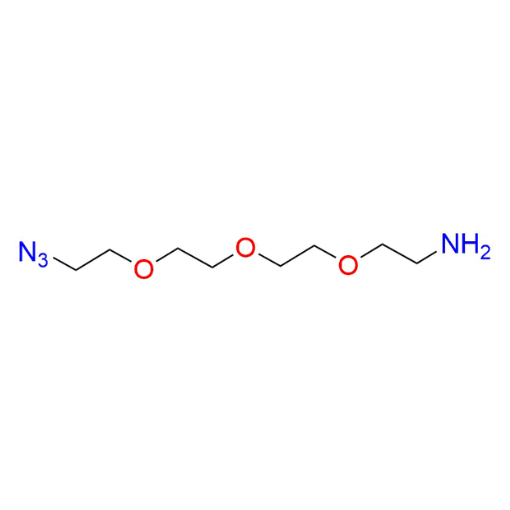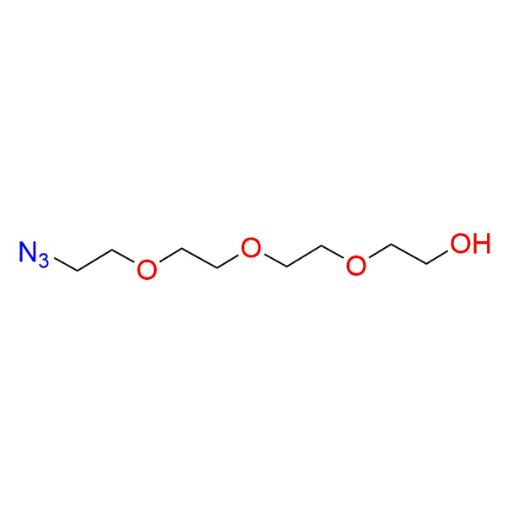
Name: 2-(2-(2-(2-Azidoethoxy)ethoxy)ethoxy) ethanol (98%)
Molecular Formula: C8H17N3O4
CAS#: 86770-67-4
SMILES: OCCOCCOCCOCCN=[N+]=[N-]
MDL#: MFCD03701128
Catalog#: AMTGC272-AO17
Molecular weight: 219.24 g/mol
Other names:
- Azido-PEG4-alcohol
Fields of Interest: PEGylation, click chemistry, bioconjugation, surface modification, materials science
Background & Applications:
Background
2-(2-(2-(2-Azidoethoxy)ethoxy)ethoxy)ethanol, also known as Azido-PEG4-alcohol (CAS 86770-67-4) is a monofunctional azide-functionalized PEG derivative based on a PEG3 backbone, featuring a terminal azide group and a hydroxyl group at the opposite end. The polyethylene glycol chain provides hydrophilicity, flexibility, and compatibility with aqueous and biological environments, while the hydroxyl functionality offers additional derivatization options or can remain unreactive for controlled, single-point conjugation. The azide group enables efficient bioorthogonal click chemistry, including CuAAC and strain-promoted azide–alkyne cycloaddition. This compound serves as a versatile intermediate within a comprehensive portfolio of functionalized PEGs designed for precise molecular modification.
Applications
2-(2-(2-(2-Azidoethoxy)ethoxy)ethoxy)ethanol is commonly used in bioconjugation, surface modification, and materials science applications where monofunctional azide reactivity and defined PEG spacing are required. Typical uses include click-based attachment of PEG chains to small molecules, polymers, or surfaces to improve solubility and reduce non-specific interactions, preparation of PEGylated probes and intermediates, and development of functional materials. As part of a robust functionalized PEG product line, this azido PEG alcohol supports modular design strategies for pharmaceutical research, diagnostics, biomaterials, and specialty chemical synthesis.
Appearance: Colorless liquid
Purity: 98%
Storage: 0-3 °C for long term storage
Solubility: DCM, Chloroform, MeOH
Literature:
- Journal of Organic Chemistry, 2001, vol. 66, # 13, p. 4494 – 4503
- Tetrahedron Asymmetry, 2000, vol. 11, # 1, p. 95 – 111