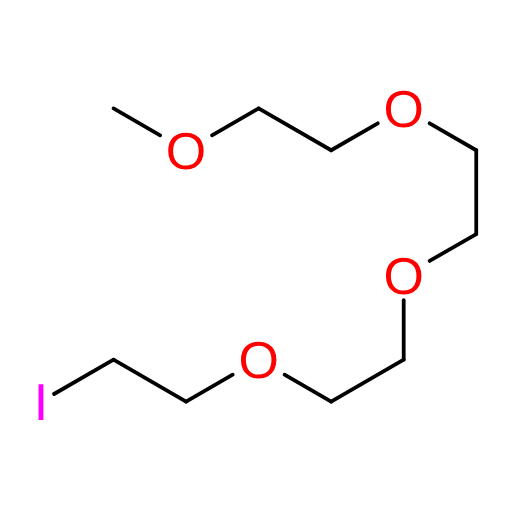
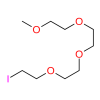
13-Iodo-2,5,8,11-tetraoxatridecane (98%)
Molecular Formula: C9H19IO4
CAS#: 143127-81-5
SMILES: ICCOCCOCCOCCOC
MDL#: MFCD28016369
Catalog#: AMTGC341-IT17
Molecular weight: 318.15 g/mol
Appearance: Orange Liquid
Purity: 98%
Storage: sealed, dry, protected from light at 2–8 °C
Solubility: Dichloromethane, Chloroform, Methanol
Other names:
- Me-PEG3-CH2CH2I
- m-PEG4-I
- Methoxy-PEG4-iodide
- mPEG4-I
Fields of Interest:
Functionalized PEGs, PEG linker synthesis, organic synthesis, medicinal chemistry, drug discovery, materials science, organic electronics, molecular probe synthesis, polymer chemistry, surface functionalization, specialty chemical synthesis
Background
13-Iodo-2,5,8,11-tetraoxatridecane (CAS 143127-81-5) is a monofunctional, discrete oligoethylene glycol derivative commonly referred to as m-PEG4-I. Its structure consists of a defined PEG4 chain bearing a relatively inert methoxy terminus at one end and a primary iodoethyl group at the other. This combination provides a flexible, hydrophilic oligoether segment together with a synthetically useful alkyl iodide for further molecular modification. PubChem identifies the compound as C₉H₁₉IO₄ with the IUPAC name 1-[2-[2-(2-iodoethoxy)ethoxy]ethoxy]-2-methoxyethane.
The terminal iodide is an effective leaving group in nucleophilic substitution chemistry. Compared with the corresponding alkyl chloride, the carbon–iodine bond generally provides a more substitution-reactive terminus, making m-PEG4-I useful when efficient incorporation of a defined methoxy-terminated oligoethylene glycol chain is desired. The methoxy group caps the opposite end of the molecule, so the compound functions primarily as a single-point PEGylating or alkylating building block rather than a bifunctional crosslinker.
Because the PEG4 segment is discrete rather than polydisperse, it provides a reproducible molecular length and composition. This can be advantageous in research where controlled molecular spacing, polarity, flexibility, or oligoethylene glycol content is important.
Applications
m-PEG4-I is particularly useful as a synthetic intermediate for installing a methoxy-terminated PEG4 chain onto nucleophilic substrates. Its primary alkyl iodide can participate in substitution reactions with appropriate oxygen-, sulfur-, nitrogen-, and other nucleophilic species, allowing a defined oligoethylene glycol segment to be incorporated into more complex molecules.
Published research demonstrates this utility directly. The compound has been reacted with sulfur-containing precursors to introduce tetraethylene glycol side chains into tetrathiafulvalene-annulated porphyrazines, demonstrating its value in constructing functional organic and electronic materials. It has also been used through nucleophilic substitution to introduce an oligoethylene glycol side chain into a Y6-derived non-fullerene electron acceptor for organic photovoltaics. In that work, glycolation was investigated as a strategy for modifying molecular dipole moment, dielectric properties, and photovoltaic behavior.
Beyond materials chemistry, the compound has documented use in medicinal and bioactive-molecule synthesis. It was prepared and subsequently employed in the synthesis of polyether analogues of the iron chelator desferrithiocin, where researchers systematically investigated the effects of polyether-chain length on physicochemical properties and iron-clearing efficiency.
These examples make m-PEG4-I relevant to medicinal chemistry, molecular linker construction, organic electronics, functional materials, and specialty synthesis. It can also serve as a precursor to other terminally functionalized PEG derivatives through displacement or transformation of the iodide. Unlike azido- or alkyne-functionalized PEGs, however, the iodide itself is best regarded as a synthetic precursor/reactive alkylating functionality rather than a bioorthogonal conjugation handle.
Literature:
- Chemistry – A European Journal, 2024, vol. 30, # 40, art. no. e202304324
- Angewandte Chemie – International Edition, 2024, vol. 63, # 20, art. no. e202402616
- JACS Au, 2021, vol. 1, # 10, p. 1733 – 1742
- Bergeron, R. J.; Wiegand, J.; McManis, J. S.; Bharti, N.; Singh, S. “The Impact of Polyether Chain Length on the Iron Clearing Efficiency and Physiochemical Properties of Desferrithiocin Analogues.” Journal of Medicinal Chemistry 2008, 51, 3913–3923.
- This paper provides especially strong exact-compound support: the experimental section reports preparation of 13-iodo-2,5,8,11-tetraoxatridecane (compound 9) in 94% yield and uses the PEG-derived building block in the synthesis of polyether-modified desferrithiocin analogues. The study examines how varying polyether-chain length affects properties relevant to iron-chelator design.
- Li, Y.; et al. “Asymmetric Glycolated Substitution for Enhanced Permittivity and Ecocompatibility of High-Performance Photovoltaic Electron Acceptor.” JACS Au 2021. DOI: 10.1021/jacsau.1c00306.
- This study directly uses 13-iodo-2,5,8,11-tetraoxatridecane in a nucleophilic substitution reaction to install a glycolated side chain on a fused-ring precursor used to construct the Y6-4O photovoltaic electron acceptor. It provides excellent exact-compound evidence for the reagent’s application in organic electronics and functional-material synthesis.
- “The Synthesis and Properties of Unsymmetrical Porphyrazines Annulated with a Tetrathiafulvalene Bearing Two Tetraethylene Glycol Units.” Dyes and Pigments 2010, 87, 89–94.
- The authors used 13-iodo-2,5,8,11-tetraoxatridecane directly to introduce tetraethylene glycol substituents into a tetrathiafulvalene-containing precursor, which was subsequently incorporated into unsymmetrical porphyrazines. This gives additional exact-compound precedent in porphyrinoid, redox-active, and functional-material chemistry.
- “Negishi Cross-Coupling Provides Alkylated Tryptophans and Tryptophan Regioisomers.” Chemistry – A European Journal 2021. DOI: 10.1002/chem.202103353.
- This study evaluated 13-iodo-2,5,8,11-tetraoxatridecane as an alkyl iodide coupling partner in attempts to diversify protected tryptophan derivatives. Notably, the particular Negishi reaction with this PEG iodide did not yield the desired product, making this a useful literature reference for both the compound’s explored synthetic applications and limitations.