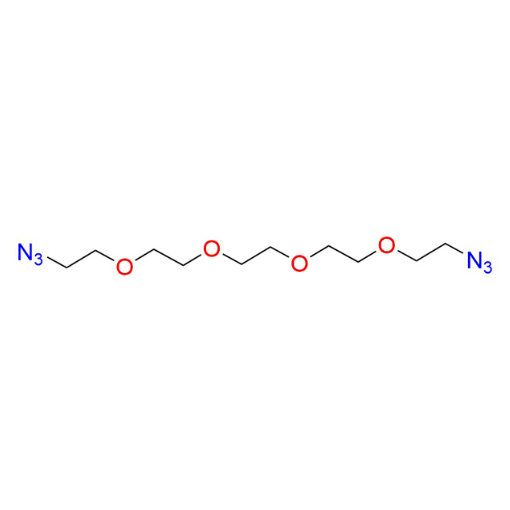
Name: 1,14-Diazido-3,6,9,12-tetraoxatetradecane (98%)
Molecular Formula: C10H20N6O4
CAS#: 182760-73-2
SMILES: [N-]=[N+]=NCCOCCOCCOCCOCCN=[N+]=[N-]
MDL#: MFCD08067376
Catalog#: AMTGC260-DA17
Molecular weight: 288.3 g/mol
Other names:
- Diazido-PEG4
- α,ω-Diazido-PEG4
- 1,14-Diazido-tetraethylene glycol
- PEG4 diazide
- PEG4 bis-azide linker
Fields of Interest: Crosslinking, bioconjugation, PEGylation, click-chemistry
Background & Applications:
Background
1,14-Diazido-3,6,9,12-tetraoxatetradecane is a symmetrical diazide-functionalized PEG linker based on a PEG4 backbone, featuring azide groups at both termini. The polyethylene glycol spacer provides hydrophilicity, flexibility, and reduced non-specific interactions, making this compound well suited for use in aqueous and biological environments. The terminal azide functionalities enable highly efficient bioorthogonal click chemistry, including CuAAC and strain-promoted azide–alkyne cycloaddition, allowing simultaneous or stepwise conjugation at both ends. This bifunctional linker is a key building block within a versatile portfolio of functionalized PEGs designed for controlled molecular coupling and network formation.
Applications
1,14-Diazido-3,6,9,12-tetraoxatetradecane is commonly used in crosslinking, bioconjugation, and materials science applications requiring dual click reactivity and defined PEG spacing. Typical uses include the construction of PEG-based hydrogels, surface and polymer modification, and assembly of multifunctional macromolecules and conjugates. As part of a comprehensive functionalized PEG product line, this diazido PEG linker supports modular design strategies in drug delivery, biomaterials, diagnostics, and advanced materials development where precise spacing and reproducible crosslinking are critical.
Appearance: Light orange liquid
Purity: 98%
Storage: 0-3 °C for long term storage
Solubility: DCM, Chloroform, MeOH
Literature:
- Chemical Communications, 2025, vol. 61, # 14, p. 3001 – 3004
- Journal of Medicinal Chemistry, 2009, vol. 52, # 15, p. 4903 – 4910