
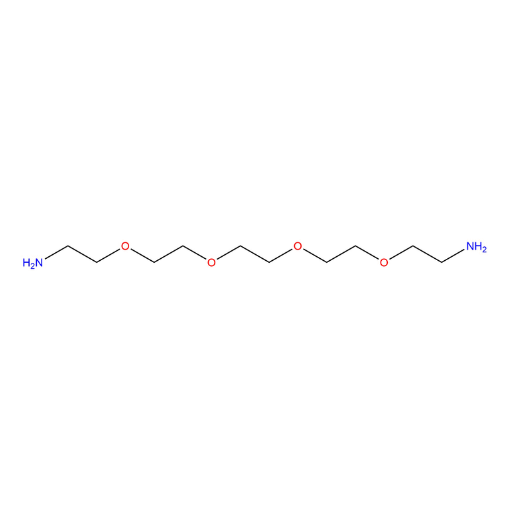
Name: 1,14-Diamino-3,6,9,12-tetraoxatetradecane
Molecular Formula: C10H24N2O4
CAS#: 68960-97-4
SMILES: NCCOCCOCCOCCOCCN
MDL#: MFCD01365938
Catalog#: AMTGC946-DT21
Molecular weight: 236.31 g/mol
Other names:
- 3,6,9,12-TETRAOXATETRADECANE-1,14-DIAMINE
- PEG4 diamine
- α,ω-Diamino-tetraethylene glycol
- NH₂-PEG4-NH₂
Fields of Interest: bioconjugation, crosslinking, and materials science
Background
1,14-Diamino-3,6,9,12-tetraoxatetradecane is a symmetrical, bifunctional amine-terminated PEG derivative based on a PEG4 backbone, featuring primary amine groups at both termini. The polyethylene glycol spacer provides hydrophilicity, flexibility, and compatibility with aqueous and biological environments while offering defined linker length for spatial separation and reduced steric hindrance. The terminal primary amines enable efficient coupling to activated carboxylic acids, NHS esters, isocyanates, aldehydes, and related electrophiles. This diamine PEG serves as a versatile building block within a comprehensive portfolio of functionalized PEGs designed for modular molecular assembly and crosslinking.
Applications
1,14-Diamino-3,6,9,12-tetraoxatetradecane is commonly used in bioconjugation, crosslinking, and materials science applications where dual amine reactivity and PEG spacing are required. Typical uses include preparation of PEG-based polymer networks, stepwise synthesis of multifunctional linkers, PEGylation of biomolecules and polymers, and surface or nanoparticle modification. The presence of two reactive primary amines enables formation of stable amide, urea, or imine-linked conjugates, making this compound especially useful in polymer chemistry, biomaterials development, and pharmaceutical intermediate synthesis. As part of a robust functionalized PEG product line, this PEG4 diamine supports modular design strategies in diagnostics, specialty chemical synthesis, and advanced materials development.
Appearance: Colorless liquid
Purity: 98%
Storage: Room Temp
Solubility: Dichloromethane, Chloroform, Methanol
Literature:
- Inorganic Chemistry, 2015, vol. 54, # 14, p. 6807 – 6820
- Journal of Polymer Science, Part A: Polymer Chemistry, 2016, vol. 54, # 20, p. 3294 – 3302