
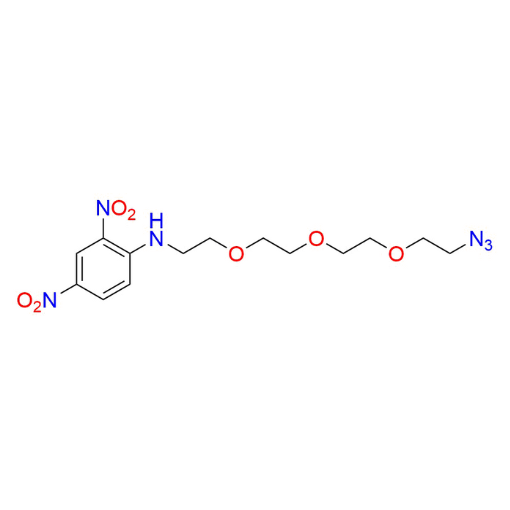
Name: N-(2-(2-(2-(2-azidoethoxy)ethoxy)ethoxy)ethyl)-2,4-dinitroaniline (99%)
Molecular Formula: C14H20N6O7
CAS#: 951671-87-7
SMILES: O=[N+](C1=C(NCCOCCOCCOCCN=[N+]=[N-])C=CC([N+]([O-])=O)=C1)[O-]
MDL#: none found
Catalog#: AMTGC1232-DN24
Molecular weight: 384.34 g/mol
Other names:
- DNP-PEG3-azide
Fields of Interest: PEGylation, bioconjugation, chemical probe development, materials science
Background & Applications:
Background
N-(2-(2-(2-(2-azidoethoxy)ethoxy)ethoxy)ethyl)-2,4-dinitroaniline (CAS 951671-87-7) is an azide-functionalized PEG conjugate featuring a PEG4 spacer linking a terminal azide group to a 2,4-dinitroaniline aromatic moiety. The polyethylene glycol chain imparts hydrophilicity, flexibility, and improved solubility, while spatially separating the aromatic functionality from the reactive azide. The azide group enables efficient bioorthogonal click chemistry, including CuAAC and strain-promoted azide–alkyne cycloaddition, allowing site-specific attachment to alkynyl-functionalized molecules or surfaces. This compound expands the scope of functionalized PEGs beyond simple linkers by integrating a defined aromatic functionality.
Applications
This azido-PEG–dinitroaniline derivative is used in bioconjugation, materials science, and chemical probe development applications where controlled presentation of an aromatic or chromophoric group is required. Typical uses include click-based attachment of the dinitroaniline motif to polymers, surfaces, or biomolecules, preparation of functional probes and intermediates, and incorporation into advanced materials for sensing or mechanistic studies. As part of a comprehensive functionalized PEG product line, N-(2-(2-(2-(2-azidoethoxy)ethoxy)ethoxy)ethyl)-2,4-dinitroaniline supports modular design strategies that combine PEG solubility with specialized functional groups for research and specialty chemical applications.
Appearance: Viscous, orange liquid
Purity: 99%
Storage: 0-3 °C for long term storage
Solubility: MeOH, Chloroform, EtOAc, Ether
Literature: Organic Letters, 2007, vol. 9, # 18, p. 3551 – 3554