
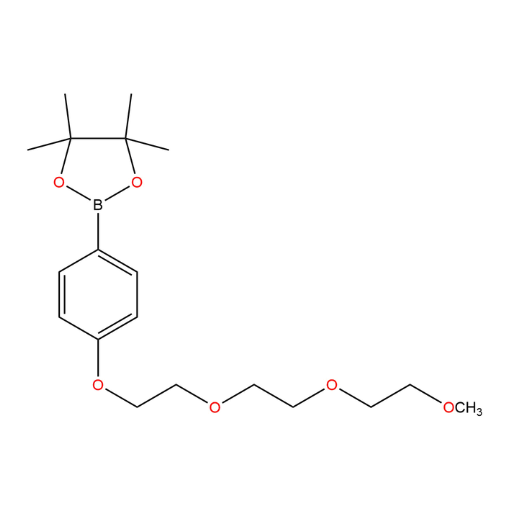
Name: 2-(4-(2-(2-(2-methoxyethoxy)ethoxy)ethoxy)phenyl)-4,4,5,5-tetramethyl-1,3,2-dioxaborolane
Molecular Formula: C20H33BO6
CAS#: 1639849-19-6
SMILES: CC1(C)OB(OC1(C)C)C2=CC=C(OCCOCCOCCOC)C=C2
MDL#:
Catalog#: AMTB582-TO12
Molecular weight: 380.28 g/mol
Other names:
- 4-(2-(2-(2-Methoxyethoxy)ethoxy)ethoxy)phenylboronic acid pinacol ester
- Methoxy-PEG4 phenyl boronic ester
- PEG4 aryl boronate linker
Fields of Interest: Suzuki-Miyaura cross-coupling chemistry, medicinal chemistry, materials science
Background & Applications:
Background
2-(4-(2-(2-(2-methoxyethoxy)ethoxy)ethoxy)phenyl)-4,4,5,5-tetramethyl-1,3,2-dioxaborolane (CAS 1639849-19-6) is a boronic ester-functionalized PEG derivative featuring an aryl boronic acid pinacol ester linked to a methoxy-terminated PEG4 chain. The polyethylene glycol segment provides hydrophilicity, flexibility, and enhanced solubility in both aqueous and organic systems, while the boronic ester functionality serves as a stable and efficient partner for Suzuki–Miyaura cross-coupling reactions. Pinacol boronate esters are widely favored over boronic acids due to their improved stability and ease of handling. This compound represents a versatile building block within a comprehensive portfolio of functionalized PEGs designed for modular assembly and carbon–carbon bond formation.
Applications
This PEGylated aryl boronic ester is commonly used in cross-coupling chemistry, medicinal chemistry, and materials science applications where enhanced solubility and extended PEG spacing are required. Typical uses include palladium-catalyzed coupling with aryl or vinyl halides to construct substituted aromatic systems, synthesis of PEG-modified pharmaceutical intermediates, and preparation of functional polymers and advanced materials. The methoxy-capped PEG chain enables controlled, monofunctional incorporation of PEG, helping to reduce non-specific interactions and improve physicochemical properties. As part of a robust functionalized PEG product line, this compound supports modular design strategies in drug discovery, diagnostics, and specialty chemical synthesis.
Appearance: Pale Yellow Liquid
Purity: 99%
Storage: Room Temp
Solubility: Dichloromethane, Chloroform, Acetonitrile
Literature:
- Journal of the American Chemical Society, 2017, vol. 139, # 23, p. 7693 – 7696
- Chemistry – A European Journal, 2018, vol. 24, # 14, p. 3408 – 3412
- Angewandte Chemie – International Edition, 2018, vol. 57, # 3, p. 818 – 822